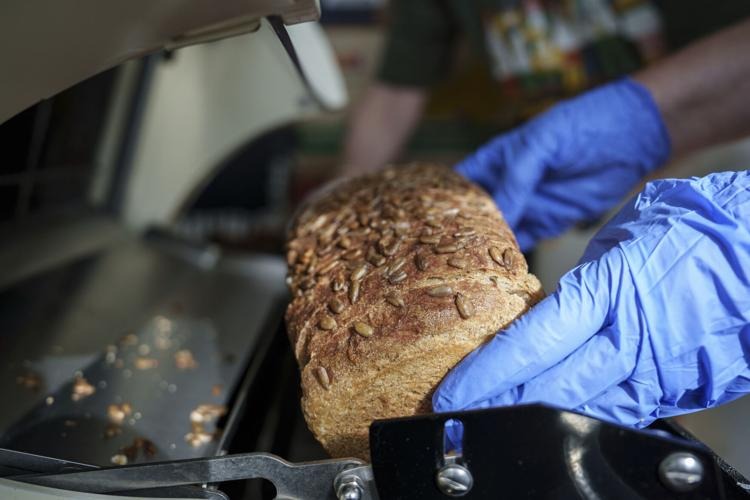
On a brisk September Saturday morning at about 8:30, a car pulls into the church parking lot in Columbus, Ohio. The car trunk opens to display an array of sourdough boules still warm from baking, sandwich loaves wrapped in wax paper, and a handful of bagels tucked into brown-paper bags. Volunteers swiftly rush in with the loaves to be sorted and sent off to the City’s Food Banks.
The baker is a home baker, not a professional one. This baker might be working as a nurse; last week it was engineers, retired teachers, and a teenager who was learning via YouTube to braid challah. They have grown into an empowering informal network of home bakers, now numbering over 900 – who have stepped up to fulfill one of the simplest, yet most urgent, needs of the food banks: bread.
The Rising Loaf Movement
The movement, informally named Rising Loaf, emerged out of a neighborhood text chain during the gloomy early months of the pandemic. Few friends in Portland noted that food banks lacked fresh loaves of bread. With grocery store supply chains being frayed and commercial bakeries being stretched thin, any donated bread was gone almost immediately.
And so, the baking began: a dozen loaves, then fifty. News spread across social media. Soon, there were hundreds of home bakers sharing tips on starter maintenance, quick-rise sandwich bread recipes, and organizing drop-off points with spreadsheets. By 2025, Rising Loaf reached out to volunteers in 38 states donating thousands of loaves collectively every week.
“They have rice, canned beans, boxed pasta. What they don’t always have is something soft, fresh, and comforting,” said co-founder and home baker Alicia Ramirez. “Bread feels human. It’s dignity on a plate.”
Bread: Both Symbol and Sustenance
Bread is one of the civilization’s oldest and most essential staples. It is a metaphor as much as it is literal—breaking bread stands for the community. Quite the opposite, in today’s America, bread is a solemn indicator of inequality: shelves available with artisanal sourdoughs and heritage grains. For many families, fresh bread is a luxury.
The USDA found over 44 million Americans are food insecure, with record levels of visits to food banks being registered. On the other hand, the price of bread has increased 27% in the last five years. “With bread, sandwiches can be packed for school lunches and toast for breakfast; it is just something for dinner to fill up on,” said Malik Johnson, a food pantry director from Detroit. “But we almost never have enough of it.”
Every week, a patchwork of Slack channels, Facebook groups, and local WhatsApp chats allows Rising Loaf volunteers to stay in touch. Bakers sign up for shifts: perhaps ten sandwich loaves for Monday, six sourdough boules for Friday. Drop-off points are created at churches, libraries, and a yoga studio. A few larger pantries have volunteers who act as drivers for collecting loaves, much like milkmen of days gone by.
“It’s chaos, but a beautiful chaos,” remarks Ben Thomas, a college student in Boston who schedules for that city. “We will have 70 loaves pledged, then someone will text at midnight saying they’ve got two dozen bagels coming out of the oven.”
Most bakers pay for their own flour and yeast, but in some locations, grocery stores have been donating ingredients by the truckload. Thanks to a community foundation, Rising Loaf also received a $10,000 grant in Minneapolis to partially cover bakers’ expenses.
Not all are just sandwich bread. Some bakers would bake gluten-free loaves and rolls using chickpea flour. Others bring anything from sweet bread, brioche, to sweaky cinnamon swirls. “It feels really good to warm your soul with food,” says Johnson. “The kids’ eyes light up when it’s banana bread.”
A Loaf, A Story
Each baker has a reason for joining.
Retired teacher Linda Park of Seattle started to bake for food-banks to keep herself busy after her husband had passed away. “The house felt empty,” she says. “Now, when I bake, I feel like I’m part of something bigger.”
For eighteen-year-old Jasmine Patel, what began as a service project has now become quite an obsession. She learned to braid challah from TikTok and now donates two loaves every Friday. “I just feel so cool knowing a family might have this on their table tonight,” she said.
For some, it’s personal. “I grew up in a house where food stamps ran out before the end of the month,” says Chicago baker Marcus Evans. “Sometimes we had ketchup sandwiches. Now I can make sure some kid doesn’t have to do that.”
The Rising Loaf hasn’t been without obstacles. Health regulations around home-baked goods vary widely by state. Some of the food banks can accept only bread that is commercially produced. Others have circumvented the law by distributing home-baked loaves through informal community channels and not official pantries.
For another thing, the cost: flour, yeast, butter, and sugar. Many bakers consider these expenses a donation yet cannot sustain such generosity. “I want to bake forever, but my grocery bill doubled,” says Evans.
Burnouts indeed exist. Organizing hundreds of volunteers, coordinating their drop-offs, and putting into action the bread worthy of great cause is any small task. “It’s joyful, but exhausting,” reflects Ramirez, “and as I speak, we are trying to figure out ways to make this movement sustainable.”
But, still, there is an element that can transform a pantry: the presence of everyday bread.
“When we distribute food, we allow families to choose what they want. The people rush for euro wheat bread,” Johnson says. “They cradle it like gold.”
Nutritionists term fresh bread not only as calories but comfort. “Food is psychological,” states Dr. Naomi Feldman, an NYU public health expert. “Fresh bread may just provide people with some dignity and a little bit of normalcy. That is as important as the nutrition.”
Beyond Bread: The Bigger Change
Rising Loaf is fast becoming a front-runner in generic food activism. Volunteers all over the country are filling the gaps created by a stressed food system. From community refrigerators to urban farms, people are finding ways to take fresh food straight to their neighbors.
“Kinda like bread, it may seem small, but it symbolizes a change,” Feldman says. “That shift is that people aren’t waiting for big institutions to solve food insecurity anymore; they now get down and dirty-a little bit of elbow grease, and in this case, a little bit of dough rolling.”
There are also talks among leadership about formalizing the program into a nonprofit, or leaving it to remain a shadowy cultural movement. “Being scrappy is power,” Thomas contends. “Structure might pull us even to the families.”
For now, the bread is still flowing. That Saturday in Columbus, the loaves carried by the nurse from her truck joined hundreds more-focaccia, rye, honey oat-piled high on folding tables. Within hours, they’d be wiped out, finding their way into the eager hands of families heading home with groceries.
“It’s not going to solve hunger,” says Ramirez. “But it is one meal, one day, one loaf. Sometimes, however, that is enough.”