
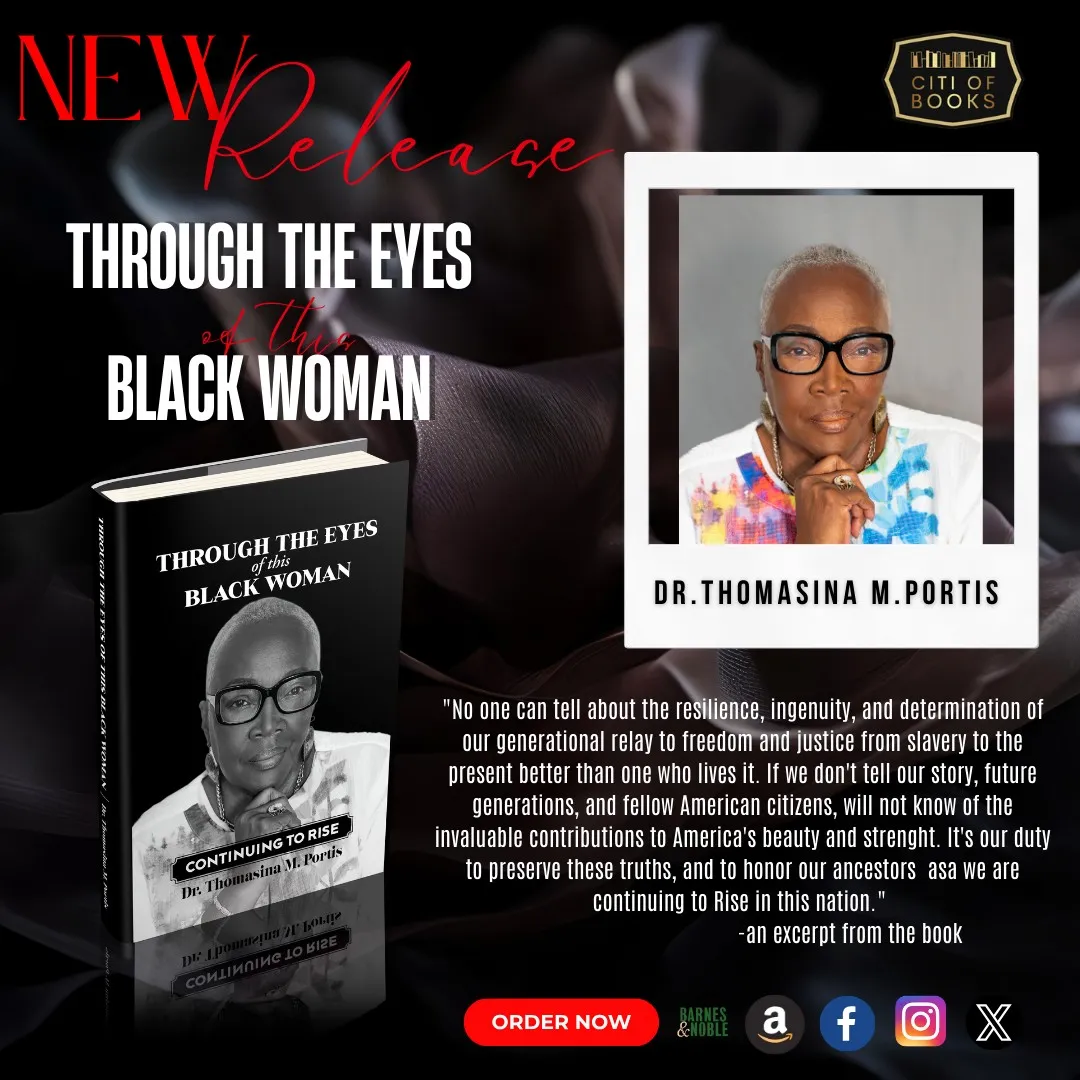
In the summer of 2025, as America remains haunted by renewed and fierce debates about issues of ethnicity, education, and the competing narratives that form the national memory, one voice has continued to vibrate with both the force of history and that of faith. That voice belongs to Dr. Thomasina M. Portis, author, educator, clergy, and community leader, whose book Through the Eyes of This Black Woman: Continuing to Rise amounts to being hailed as a testament of perseverance and a call to action.
Portis is not merely writing an autobiography. It is a broad-ranging historical commentary that characterizes the plight if Black lives in America with biblical interpretation and cultural commentary to create a narrative about their ingenuity, resistance, and victory. Here in the text, the reader can imagine her unabashed voice insisting upon remembering, reclaiming, and retelling truths that have all too frequently been ignored, denied, or erased.
“Every story matters, especially when so many have been silenced,” Portis declared in a recent interview. “The struggle of Black Americans is not a footnote – it is the heartbeat of this nation.“

A Childhood Shaped by Segregation, A Life Shaped by Service
Portis, born and bred in South Carolina, had childhood years marked under the shadow of segregation. She recalls the disparity in Black and White school curricula as she expresses the correlation of formal education in financial literacy and economics provided to white students and their formal preparation to become financially solvent to the history of financial lack in most black lives throughout generations. “It was a vivid example of systemic inequality,” she writes, “not just in money, but in opportunity.“
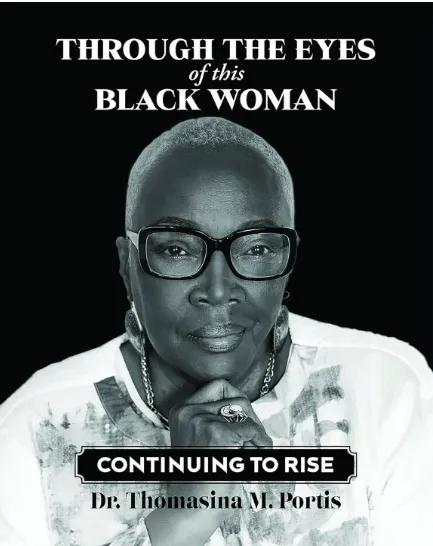
The deliberate unequal formal education training awareness became a thread woven throughout her life and propelled her to become one of the fourth-generation educators in her family. Portis began teaching music and humanities and eventually rose through the ranks to become an Assistant Superintendent in the public school system for the District of Columbia and a global education consultant. Along the way, she began mentoring and advocating for youth and young adults.
Her résumé is a c montage of titles and career directions: an adjunct professor at several universities, a counselor for the national Christian body, an accredited chaplain, a former pastor, an international lecturer. She counselled survivors of the Oklahoma City bombing. She raised funds to bring children from Ghana to the United States for life-saving surgeries. She led enrollment drives that enabled more than a thousand students to attend HBCUs.
Since all of these accomplishments, for Portis, are really only extensions of a calling, she says: “God gave me gifts. I was responsible for using them to help others rise.“
A Book That Reflects on America
Through the Eyes of This Black Woman: Continuing to Rise is, first and foremost, a reminder of how the incomplete American story leaves all citizens uninformed regarding the contributions of all of its citizens to this great nation. Portis makes several parallels between Paul the Apostle’s letters regarding the mistreated Gentile communities to the mistreatments of Brown and Black Americans.
The book refers to Systemic Racism through present-day redlining, gerrymandering, victimization through voting precautions, economic inequality, then refers to former slavery and Jim Crow. These show the continuity, through eras of inhumane treatment to Black Americans. It, however, does not resign itself to bitterness. It reiterates throughout the conversations, in Portis’s words, how her community has risen time and time again against tremendous odds, obverse past genius and perpetual brilliance.
“Dr. Portis straightaway chronicles the historical and current backdrop of that seemingly intentional disparagement of Black communities economically,” Professor Lucy J. Reuben, Former Chairperson, Board of Trustees, at Morris College, wrote. “This book should be a must-read for economics students and policymakers alike.”
Others echo these sentiments, noting how the book unites scholarship with soul: One called it “scholarship with urgency,” while another remarked that it felt “like stepping into a journey of truth, resilience, and unshakable hope.“
For the author herself, the book is more than literature; it is a movement. “We cannot allow revisionist history to erase the legacy of those who endured and fought for freedom,” Portis says. “Our children need to know the truth, and our legislators need to reckon with it.“
The Relay to Liberty and Justice
While Portis refers to the relay as the metaphor for freedom and justice, she reminds the reader that each generation must continue the determination and movement that brings equality and dignity to all humanity, regardless of ethnicity or class. She describes this movement as a Relay to Liberty and Justice for all. Every reader is encouraged to carry this baton with the inspiration of hope, freedom and prosperity for all Americans.
She features stories of her ancestors, her children, and her own experiences in this relay. From the mid-1800s onwards she came from a line of educators and farmers who endured the harsh conditions of Jim Crow.
Portis continues to see herself as an educator, civil service leader who has lectured on six continents and considers as relays and hand-offs to others as they continue the Relay to Liberty and Justice for humanity-at-large and Black people specially in America.
“It’s not a sprint,” Portis writes. “It’s a relay. We may not finish the race ourselves, but we must pass the baton faithfully to those who come after us.”
Another argument carries an intergenerational accusation, as America continues to have fierce arguments over what critical race theory. It is concerning the depth to which Black history should be taught in school districts and legislatures. The stakes could not be clearer for Portis. “Our history is not up for erasure,” she said. “The moment we allow silence; we lose the future.“
Beyond the Page: A Life of Impact
But Portis’s message is made powerful by the credibility of a life lived in service.
She has spoke to educators, legislators, and clergy across continents. She shares the honor it was to speak at her late daughter’s graduation when she delivered the Protestant Baccalaureate Sermon at Brandeis University. Among her service activities, she chaired the Boy Scouts of America’s Learning for Life Education Program – the first Black woman to hold that post, joined other pioneers during the push for Values and Character Education as a qualitative component of education to become part of public education’s curriculum – and she was a consultant for Eunice Kennedy Schriver’s Community of Caring component of her Special Olympics Organization.
Portis attempts to close the gaps of her interest – whether between faith and justice, education and empowerment, history and hope.
Her second book, Music Matters: A Universal Language and Ministry, expands this mission by treating music as a metaphor for gifts. Just as harmony forms from diverse instruments, Portis believes human progress occurs when each person goes on to cultivate their unique God-given gift.
“Music is more than sound. It is a language of the spirit that guides the soul and tells the mode and history of every society,” she said. “Like music, our gifts are meant to be used for the flourishing of humanity.“
A Story That Belongs to the World
Portis’s works have reached audiences worldwide. In 2024 and 2025, her book was showcased in Frankfurt, Germany, London, England, and Los Angeles, CA. It exposed her message to publishers, educators, and policymakers throughout Europe and the United States. This southern-born Black woman once under the influence of segregation, is now heralding a message of resilience and equity on the global stage.
The choice was an easy one for Inspire America Magazine, which will have Portis in its 2025 Collection. “Dr. Portis is the epitome of the word inspire,” said one editor. “She speaks truth with courage, lives service with integrity, and writes with urgency. Her story is not just hers – it is America’s story, and it ought to be told.“
The Urgency of the Hour
Now that political fights are waged over history textbooks and voting rights, Portis’s book is feeling the urgent push. It is not an armchair academic exercise; it is an earnest request: listen, remember, and act.
“America has always been a work in progress,” she said. “But progress requires truth. Without truth, there can be no healing, no justice, no unity.“
Her faith remains the anchor of her vision. To Portis, Christianity is the source of justice, not a tool of exclusion. She distinguishes between the liberating message of the gospel and the warped one proposed for socio-political reasons to engender ethnic separation and economic power. As she says, “True faith uplifts, unites, and heals. Anything less is not from God.“
Legacy and Future
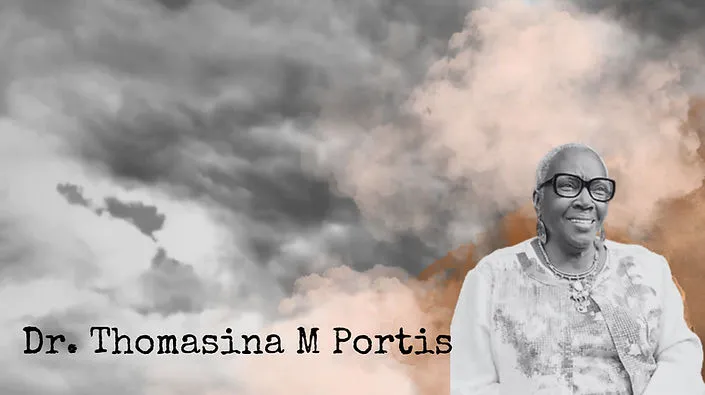
In her many years of experience, Dr. Thomasina M. Portis could have congratulated herself for her deeds recording history. That was, of course, however, out of the question: she remains in the race, still passing the baton. She continues to rise – whether it be mentoring students, writing books, or speaking at conferences – and lifting others with her.
The very challenge and yet hope lie in her message. Her charge to the reader is to confront systemic racism, yet there is no way resilience and faith cannot overcome the stain of injustice through centuries.
She writes in her prologue, “We have been pushed down, yet we rise. We have been silenced, yet we sing. We have been denied, yet we command our truth. And as long as we are continuing to rise, America may one day fulfill its promise, i.e., justice and liberty to all.” In a fractured time, that vision is both radical and restorative.
Where to Learn More
- Author Website: https://www.drtmp.org/
- Author Info Page: View Info