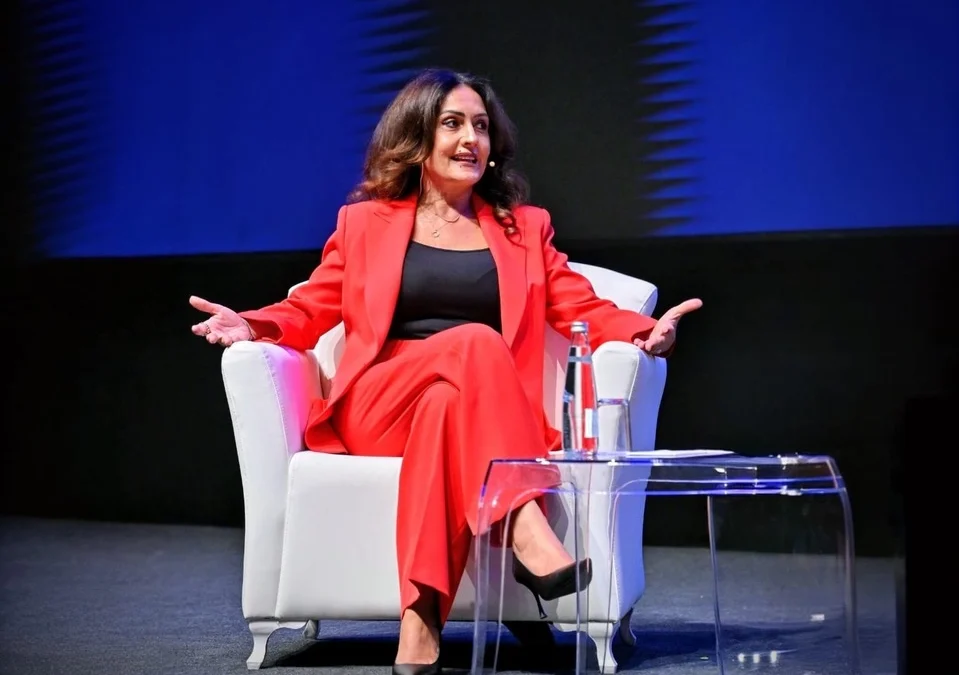

SARASOTA, Fla. – When Monica Seles, the nine-time Grand Slam champion whose name still evokes awe in ballrooms and tennis courts everywhere, initially felt her symptoms, she was doing something she had done dozens of times before: hitting a casual round of tennis with relatives.
She managed to miss a simple volley. She glanced down the court and saw two balls, mirrored images taunting her vision. It was a confusing moment that destroyed familiarity and took her down a new, unfamiliar road.
“Myasthenia gravis,” she now knows is the name of the unusual neuromuscular autoimmune condition that would change how she lives, but not who she is. Seles hid the diagnosis from the public for almost three years. Now, on the eve of the U.S. Open, she has decided to come out into the light, using her voice to raise awareness, tell her story, and speak out on behalf of those whose days are filled with uncertainty.
“It’s a hard one … it impacts my everyday life very much,” she explained to The Associated Press. “But, as I say to children that I mentor: ‘You’ve got to always adjust. That ball is bouncing, and you’ve just got to adjust.’ And that’s what I’m doing now.”
Two decades ago, Seles experienced one of sport’s most horrific tragedies: being stabbed on the court in Hamburg during the peak of her dominance. Fewer tales in tennis are as heavy with import as her early years, winning eight Grand Slams before the age of 20, including a French Open at 16 and what she had to fight back from afterwards. Every stumble was, as she describes it, a “hard reset”: her emigration from Yugoslavia as a teenager, the fame and pressure, the stabbing, and then a return that resulted in a last Grand Slam in 1996.
And now MG enters that series of life-defining pivots. Unlike injury, this condition does not mend with rest or cure with surgery. It is managed, moment to moment, requiring adaptation.
Myasthenia gravis (MG) is largely unknown to the general public despite being a condition that afflicts about 20 of every 100,000 individuals. Seles is one of a small group now voicing its collective cry. MG is defined by a disruption in nerve-muscle communication that takes the form of weakness that aggravates with activity and eases with rest. Double vision, eyelid drooping, arm and leg weakness, features she recognized in her own life prior to seeing them as medical warning features.
A simple chore such as “blowing my hair out,” a typically meaningless ritual otherwise, became drudgery. She terms the diagnosis both “relief” and “reset”, a time requiring self-reflection, bravery, and honesty. “When I got diagnosed, I was like, ‘What?!'” she stated. “I wish I had somebody like me say something about it.”
Seles’s move to come out about her diagnosis was not taken lightly. She became a partner with the Dutch immunology firm argenx in its “Go for Greater” initiative, shining a light on MG during the U.S. Open this year. The goal: to channel attention into research, resources, and compassion. “By sharing my story, I can raise awareness … empower patients to advocate for themselves,” she stated.
The U.S. Open, where she formerly resided her most glorious tennis victories, is now the stage for this renaissance, a far cry from the glare of triumph. Instead of flaunting tennis talent, her presence there will trumpet activism and awareness.
As a young woman, Seles had likened the tennis ball to her life’s steady companion, until it’s removed from her. Today, the familiar power of that bounce is softened by a body that sometimes won’t comply. But her tenacity endures.
In interviews, she acknowledges how familiar that feeling is: adapting to life’s unpredictability. “That ball is bouncing, and you’ve just got to adjust.” It’s a metaphor for resilience she has practiced throughout her life: on courts, in recovery, and now amid a disease that demands daily recalibration.
Her record: 53 tournament victories, 178 weeks ranked No. 1, induction into the Hall of Fame, serves no reintroduction. But what she’s doing today speaks to something larger: an international icon leveraging fame for advocacy. By bringing attention to MG, she’s linking people together with hope, making disease less isolating.
“Having the knowledge that there is hope out there … and a wonderful community … has been really helpful,” she reported on Good Morning America, highlighting how activism fosters healing.
There is no cure for MG, yet there are treatments and support groups. Seles is now part of those helping mend that safety net.
The Seles narrative is still unwinding, no longer measured by Grand Slams and power swings alone. Although the tennis racquet feels lighter in her hand, her voice is heavier with conviction. Each endorsement, interview, and look back at the U.S. Open this year is now imbued with empathy and visibility.
In divulging her diagnosis, Seles reminds us that resilience is not always in victory: often it’s forged in vulnerability. And for her, it’s a life still being written, reset by fortune, but fueled by the same determination that made her a champion.