
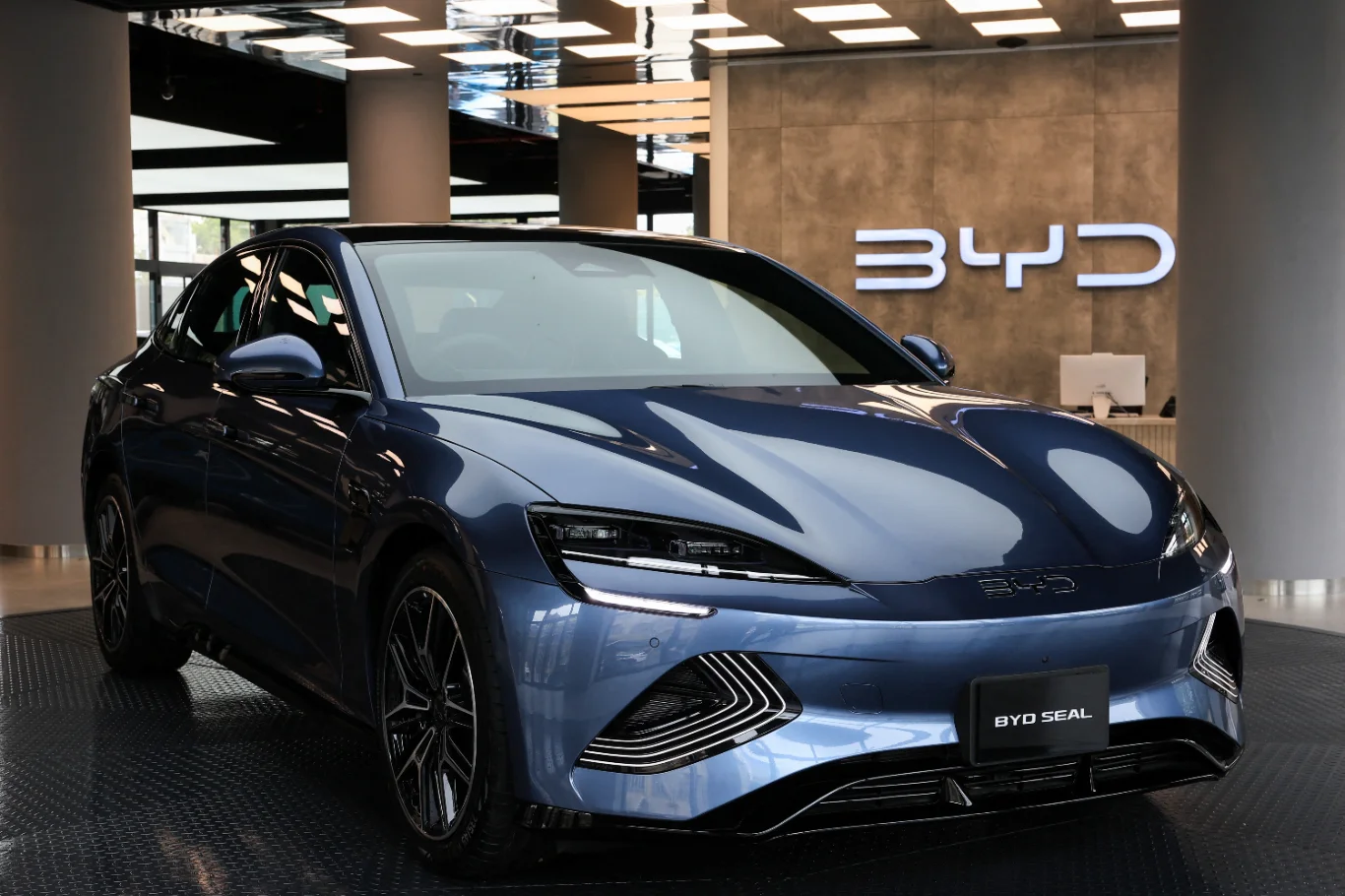
SHENZHEN, China — On a chilly December morning in this southern Chinese industrial city, workers are arriving at BYD Co.’s – the huge complex of what is now the most prolific maker of electric vehicles in the world. An almost rhythmic precision guides the production of polished sedans, SUVs, and compact cars that flow off the assembly lines. For years, Tesla Inc. occupied the throne as the undisputed king of the electric-vehicle revolution. But in 2025, the general narrative is going to change in that very way that few insiders might have expected even a decade ago.
According to the most recent industry data and projections, BYD – an ambitious battery maker turned car giant — is about to leave Tesla behind in terms of annual EV sales. With a total of over 2 million electric vehicles delivered by the end of November, BYD’s global presence and volume position it right next to its rival from the U. S. as the year comes to a close.
A Revolution in Quantity and Strategy
BYD’s climb to the top is underpinned by a very simple yet powerful formula: volume plus variety. While Tesla has almost exclusively focused on pure battery‑electric vehicles (BEVs), BYD sells a complete range of BEVs and plug‑in hybrid electric vehicles (PHEVs), thus appealing to a larger market of diverse tastes. During the year 2025, BYD’s cumulative sales figure was already surpassing that of Tesla by the end of the year amongst the first three quarters of the year, with BYD delivering 1.61 million BEVs and Tesla 1.22 million.
The company’s offerings have included low-priced compact cars, family hybrids, and larger SUVs. Discrimination of BYD through Tesla is seen largely in the latter’s neglect of segments. BYD has been particularly able to appeal to the price-sensitive markets area by its lower starting prices. Consumers in some parts of Europe and Asia have often mentioned cost of ownership and design flexibility as the main factors for their choice of BYD models instead of more expensive alternatives. Industry insiders have revealed that the combination of BYD’s competitive pricing and locally based production has helped it grow in areas that were once dominated by Western manufacturers.
For Tesla, the challenge has been more acute: a narrower model lineup and increasing competition in its staple markets — particularly China and Europe – have eroded its once‑solid foothold. Tesla is not performing its sales projection for the year in the Nordic region but rather lagging behind many of its competitors significantly. The overall electric vehicle registrations are increasing, but the company’s share is declining.
Changing Global Tides
Tesla’s struggles in 2025 are not limited to market share. In the U. S., the expiration of a $7,500 federal EV tax credit in late September reduced the incentive for consumers to purchase new electric vehicles, a factor that analysts say has dampened demand.
In parallel, geopolitical and political headwinds, including controversies surrounding the CEO Elon Musk—have also had a negative impact on Tesla’s brand image in important markets.
In contrast to Tesla’s global-brand perception issues, its rival BYD has been steadily expanding its global production and distribution networks as its international strategy, which focuses on globalization. The company’s manufacturing footprint is growing not only in China but also abroad, where new plants and collaborations are being developed to lower tariff and logistics costs while catering to local consumers’ tastes.
This diversification has provided BYD with a buffer against the impact of price-sensitive domestic markets and currency fluctuations. Even when profits have to be sacrificed at home, primarily due to the demand for lower prices, the sales growth in foreign markets has been able to support the company’s momentum.
The China Factor
The elevation of BYD is very much related to the overall changes in the EV ecosystem of China. China still is the number one market worldwide for electric vehicles where every year millions of new registrations happen. BYD draws most of its sales from the new energy vehicles in this home market which is overfilled and has passed even such competitors as Tesla quite often.
The Chinese carmakers, besides possessing domestic subsidies for a long time, have the advantage of good supply systems and fast setting up of battery manufacturing capability that are driving down the costs of the entire industry. A remarkable aspect of BYD is that it was always the foremost advocate of the idea of vertically integrated manufacturing, making its own batteries, electric motors, and other vital components, a method that has created a buffer around it against the supply chain turmoil that many Western carmakers have to face.
In addition, the manufacturing ecosystem in China has been creating strong competitors not only in the form of BYD. The likes of Leapmotor aim to reach the annual sales of several million units in the next decade, an indication of the fact that the EV market in China will be very aggressive to say the least.
The Tesla Dilemma
The differences between Tesla and BYD highlight different corporate cultures and business tactics. Tesla has been seen for a long time as the flag bearer of EV innovation and has made quite a significant investment in advanced software, autonomous driving research, and a streamlined product portfolio focused on high-performance battery electric vehicles (BEVs). Along with these, the company’s upcoming investments in autonomous robotaxis and other mobility technology innovations are meant to create new revenue streams that will not be tied to traditional auto sales.
On the other hand, the risks associated with Tesla’s huge investments have not yet been converted into stable near-term revenue. On the contrary, saturated markets in North America and Europe brought about by strong competition from Asian rivals have resulted in a significant reduction of Tesla’s sales projections for 2025.
There is a lack of consensus among investors and analysts as far as the long-term outlook for Tesla is concerned. The technological edge, especially in software and battery development, is pointed out by some as the main reason for the future rebound. Others, however, caution that loss of Tesla’s market share may foreshadow a change in EV leadership that is more widespread than just the case of Tesla losing some ground.
What This Means for the Industry
BYD’s surpassing of Tesla as the world’s leading EV supplier to a certain extent portrays the power and can be seen as a competition amongst the manufacturers. One of the main consequences is the globalization of EV competition. The story is no longer just U. S.-focused; the Asian, European, and enjoying economies markets are now also involved in the deciding of the industry leaders.
Moreover, the trend points the need for adaptability in the constantly changing EV ecosystem. The extent to which consumer preferences have changed toward cheapness and everyday usability has caused some automakers to consider introducing products that are high innovative yet not very accessible, meanwhile, the innovated ones might be the ones that have already reached the consumers, so to say, with the contemporaneousness of innovation and accessibility on the part of the consumer, some of the automakers might find themselves being positioned as better for mass adoption.
The competitive scene also forces old car manufacturers, e.g., Volkswagen and General Motors, to step up the pace of their EV transformations. The definition of the leader in the automotive industry is broadening as more consumers are now willing to buy cars from brands that are not traditional ones.
Beyond 2025
The final sales tallies in the decisive fourth quarter will determine whether BYD will finish 2025 ahead of Tesla or not. The projections indicate that during this period Tesla would deliver around 405,000 units, resulting in around 1.65 million for the full year – which is still a long way from the BYD’s November-end estimate of approximately 2.07 million.
However, even if Tesla pushes really hard at the last minute, analysts are in agreement that the lines of the trend cannot be unnoticed.
It is impossible not to see that the EV circuit in 2025 will be vastly different from that in the previous decade. BYD, currently the world’s top EV maker, was once a battery manufacturing maverick but now walks the path of global leadership and is right at the cusp of it. Its rise is a clear sign of the changing industrial power, manufacturing capacity and, most importantly, consumer preference.
The road will certainly be hard for Tesla and the numerous competitors who have to come to grips with the demand for change, creativity, and possibly the need to rethink their definition of leadership in a technology-driven world.
In such a scenario, the power to rule the EV market will no longer be in the hands of a single giant but will be shared among those who best comprehend the future route in the volatile and ever-changing 21st-century marketplace.