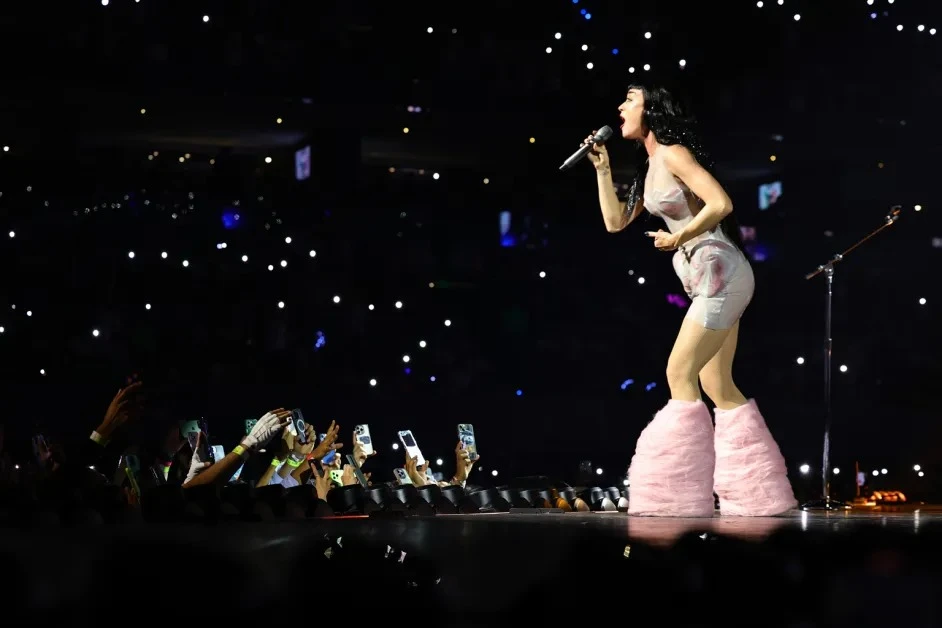
Aug. 4, 2025 – Sunday evening’s show at Detroit’s Little Caesars Arena turned somber when a young girl fan, brought on stage by Katy Perry, fainted just as the singer was about to start singing “The One That Got Away.” Perry stopped the concert at once, knelt alongside the girl, and offered an impromptu prayer, as medical staff rushed to her aid. The fan, identified as McKenna, was later reported to be in stable condition. Perry’s response was widely praised as emblematic of grace and genuine concern from an artist deeply connected to her audience
As part of her Lifetimes Tour, a global series of concerts where fans are invited on stage – Perry chose McKenna and a handful of other young fans from the audience to join in on a performance of “The One That Got Away.” McKenna, dazed and overwrought, fainted at Perry’s feet as the music was about to start. The emotional intensity highlighted how high the stakes can be when dreams cross paths with expectation in the spotlight.
Perry didn’t hesitate to react. She fell to the ground, held McKenna’s head, and stood watch as venue medics offered assistance. The arena fell silent before erupting into applause as medical personnel guided McKenna off stage on a stretcher. Perry was visibly shaken but steadfast in her demeanor, watching until she was safely out of the limelight.
As soon as McKenna was out of harm’s way backstage, Perry converted a nightmare instant into one of collective healing. She brought the other fans in for a group hug and provided a heartfelt invocation:
“Dear God, we pray for McKenna, that she will come back fully and brighter and better than ever. Amen. It’s so much. Sometimes you can be brave and get on stage, and it becomes overwhelming,I understand that feeling.”
Later in the program, suspended in a giant butterfly prop above the stage, Perry stopped singing mid-song to report: “McKenna’s doing great, by the way!” she declared, prompting relief and cheers.
The concert audience of approximately 13,000 started chanting McKenna’s name, transforming what could have been a charged moment into one of unified cohesiveness. Reactions on social media instead portrayed Perry as a performer who naturally understands how to occupy space during a crisis. One follower posted, “I have never seen any artist better handle such a moment than Katy Perry, she paused, remained with the fan, even after the medics arrived. Truly an angel.”
The moment soon went viral, and commenters praised Perry for her emotional intelligence. Consensus: guest encounters on stage can create magic, but also unpredictability. And in Perry’s able hands, the latter was addressed with dignity and respect.
Katy Perry’s Lifetimes Tour got underway in April and is now slated to continue until December, taking in four continents. A defining feature of the tour is Perry’s fan interaction having fans come out onstage regularly to make them part of collective performances that distinguish between star and fan little if at all.
Previous performances have generated buzz for elaborate production, including during one show in San Francisco when Perry was temporarily left suspended in mid-air after a butterfly prop failed. She recovered from the fright, finished the song, and soothed the audience with humor and composure.
The Detroit tragedy uncovered the emotional fragility found not only in audiences but also among artists. McKenna had embraced Perry seconds before falling over – an embrace that Perry replicated with physical and verbal support moments later. It was a reminder that concert performances are emotional environments where happiness can turn to overwhelm, and artists have to bear the unexpected in the moment at times.
Perry’s skill at switching between performer and caregiver and back again highlights her emotional intelligence. It also speaks to wider industry shifts as artists increasingly place priority on mental health and empathy as well as spectacle. Perry’s public persona as advocate and singer intersected in one breathtaking instance of compassion on a Detroit stage.
The concert continued, and Perry ended the evening on a positive note. When she performed “Roar,” she yelled McKenna’s name over the thundering applause. For some, the event became a defining experience—not for danger, but for the way live shows can be wise, engaged community affairs.
Industry analysts indicate that such instances of artist-driven care can add to a tour’s cultural value. Instead of turning away from the unvarnished human moment, Perry embraced it, reaffirming trust and bonding among artist and audience, an increasingly scarce resource in entertainment primetimer.com.
As audiences more and more become integrated into live performance, as is the situation with Perry’s interactive stage invitations, venue policies might have to change. Better preparation and medical readiness whenever non-performers are invited on stage is what experts are urging, particularly when participants involve children.
The Detroit show also brings into question how venues and crews prepare for emergencies and how fast an artist can jump into crisis response without compromising the flow of the show or safety measures.
The Lifetimes Tour continues on through August dates in Toronto, Boston, Philadelphia, New York City, and further, ending with performances throughout Latin America, Europe, Asia, and the Middle East. Perry’s skill for taking a scary moment and turning it into a moment of shared strength could be a benchmark for future live shows infused with fan engagement.
A moment intended to be a celebration of a kid’s dream almost became a crisis, but instead, it turned into an exercise in emotional humanity. At its very foundation, live music is still wildly unpredictable – and when confronted with that unpredictability, Katy Perry held firm, empathetic, and wholly present.
In Detroit, a whisper became a community gesture of healing. A show became community. And fans were reminded: the strongest moments in pop may not be born of lights or set design, but of kindness recognized in real time.