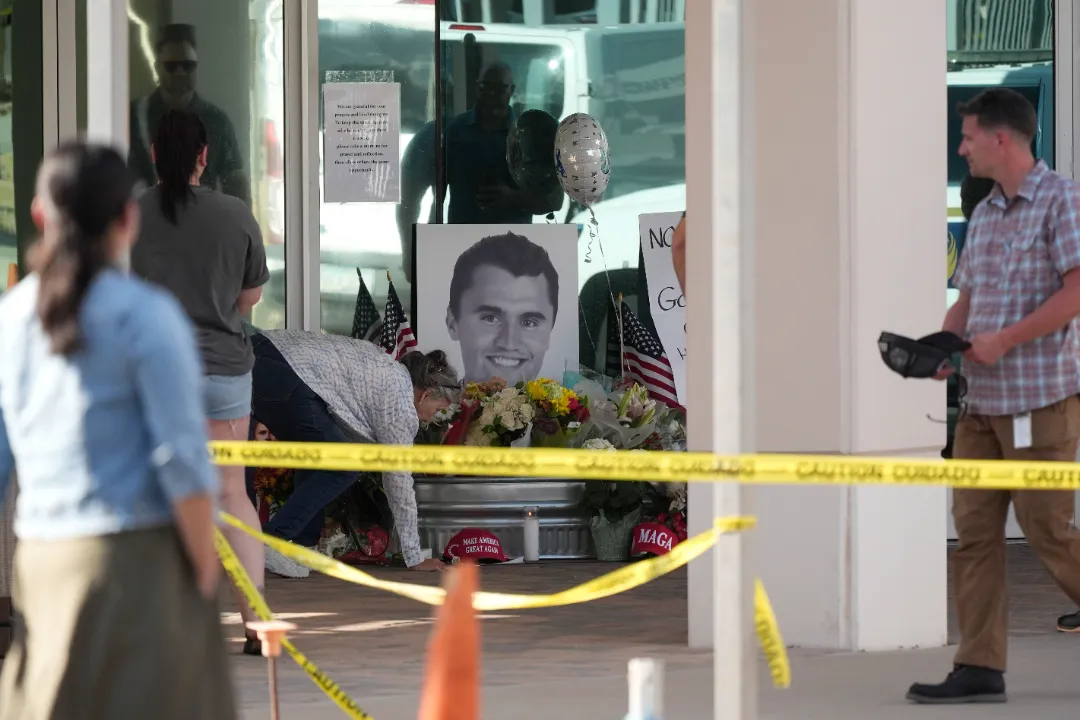
A brilliant midday in Utah Valley University, Orem, the ordinary campus event of the day permitted the carnage. As Charlie Kirk, 31 years old, the conservative activist and media personality, and also the co-founder of Turning Point USA, was being shot dead while speaking publicly on September 10, 2025, the manhunt went frantic, with a thousand leads, astounding political shock, and public outrage over the question of what kind of country are the United States becoming.
Kirk was at the university as a part of his “American Comeback Tour,” which was a high-profile conservative speaking series. The event with a “Prove Me Wrong” table and gathering of young supporters seemed to epitomize his ongoing mission of sparking debate, drowning out left-wing narratives, and energizing an entire generation of budding right-wing youth.
The shot came approximately 20 minutes into the event. With Kirk addressing the crowd in the courtyard of nearly 3,000 people, it was said the shot discharged. Witnesses said they saw him recoiling from it. Within moments, Kirk was bleeding; he was carried to Timpanogos Regional Hospital, where he was pronounced dead later that day.
Meanwhile, within hours, a full-scale investigation and manhunt for the shooter began under federal, state, and local authority. Coordination between the FBI, Utah Department of Public Safety, Utah County Sheriff’s Office, and university police was established. Initial reports indicated that the shooter fired from a building rooftop roughly 200 yards away from where Kirk stood addressing the crowd.
Investigators released surveillance video showing a dark figure wearing sunglasses and baseball caps who, in some footage, was seen jumping from the roof and running away across the campus after the shot. Unusual clues were also recovered: a high-powered bolt-action rifle (reported to be a Mauser .30 bolt-action), some shell casings, and strange engravings on unused bullets. One case read “Hey fascist!”, another referenced the song Bella Ciao, with others having homophobic slurs.
Authorities also collected a shoeprint (Converse tennis shoes), palm prints, forearm prints, and forensic evidence from the impulse rifle found in a wooded area close to campus, wrapped up in a towel.
After more than 7,000 tips, much public pressure, and 200 interviews, a suspect was found: Tyler Robinson, a 22-year-old Utah resident.
Authorities said he had become increasing political in recent years and had made several disparaging remarks against Kirk. Discord messages from Robinson, released by his roommate, referenced picking up a rifle from a drop point, leaving the gun wrapped in a towel, and demonstrated familiarity with the layout of the campus.
It is said that Robinson’s father first recognized him from the pictures put out by law enforcement, and later he was somehow delivered to the authorities by a close person, possibly his father. Robinson was then taken into custody in Washington County, Utah, some hours away by car from the place. He will have to be formally charged by the prosecutors, and there are reports that confessions (or implied admissions) by family members might have been used.
The death of Charlie Kirk, who had been an extremely controversial and very influential person in the conservative movement, has caused a storm over the whole political spectrum. Many condemn this as not merely an attack on one man but an assault on democratic norms: free speech, political participation, and civility.
Then comes the death of Donald Trump, a very loyal ally. He called it a “political assassination,” assuring that justice would be done, and said he hopes that the death penalty is bestowed upon the culprit.
Meanwhile, federal and state officials warn about the climate of hate, incitement, and political demonization that may have been fertile ground for this act on both sides of the aisle.
Though the suspect has been in custody since September 12, 2025, the case itself is still a long way from being solved. Among the investigated matters remain:
Motive: Why Kirk? Was this an ideological urge, a personal grievance, or something influenced by the forces of online radicalization? Though the bullet engravings and messages display political animosity, the full motive behind is yet to be investigated.
Knowledge and planning: The shooter’s location, choice of weapon, and route of escape give clues for premeditation. Was Robinson really acting alone? Did someone assist him in the planning, or the financing, or just the logistics?
Security protocols: How would a rifle have been positioned on the rooftop overlooking this large public event with its thousands present? What safeguards were in place or the contrary at the university event? What more universal lessons can come out of this with respect to the protection of public political events?
Public safety versus free speech: As political rallies and speaking tours mushroom, what responsibility should event organizers, universities, and government authorities assume in assessing risk and in threat mitigation? Kirk’s death brings up another tension-Fostering open debate without violence.
Charlie Kirk’s assassination touches several converging forces in U.S. politics:
Escalation in political violence – Incidents like these increase concern that political differences are no longer matters for debate but are existential threats.
Radicalization in the digital age – Encrypted chats, social platforms, and echo chambers are empowering grievances into action, especially for dissatisfied youth.
Weapon access and forensic breakthrough – Bolt-action rifles, forensic specimina such as gun-barrel markings, digital communication, shoeprints: all tools in an investigation kit that encompasses imperfection and power.
Media and rhetoric – What public figures, commentators, and elected leaders say about their vilified camps (“fascists,” “leftists,” “traitors”) matters. Many observe that political rhetoric seems to have erupted into an aggravated tone of demonization, which in turn has served to nurture an environment in which some accept violence as a legitimate form of reprisal.
Political violence has long been an American problem-the domestic terrorism, the shooting, and the assassination – but daylight terrorization of a college event committed for the purpose of killing refocused on campus politics and youth activism. That almost completely disorients one with the context. Utah Valley University-well, in the larger political landscape-must now accept the idea that no one with a public profile, no matter how divisive, is protected.
Likely, inquiries will occur surrounding the security of that event, and whether there is adequate public funding for protection and surveillance. Gun regulation and hate speech may also be legal issues to be addressed. For those that support Kirk, the event is being remembered not just for its tragedy but as a rallying cry: to honor Kirk’s mission, defend free speech, and review the responsibilities and obligations of citizens and officials in guarding against political violence.
Thus, the death of Charlie Kirk became a point of contention. Charlie was popular yet divisive; he lived at the crux of culture wars in America. His killing, the mad chase, and the visceral reaction it has erupted into do not reflect just a criminal act but also an expression of a deeper fissure in the national fabric – identity, speech, ideology, and the limits of what can be done in the name of political life.
With Tyler Robinson in custody, many questions still remain. Accountability, motive, and prevention shall be tested in coming days, weeks, and years, plus America’s ability to respond to a tragedy without unraveling even more. The story is still unfolding, but its significance-juridical, societal, and moral-is already profound.