
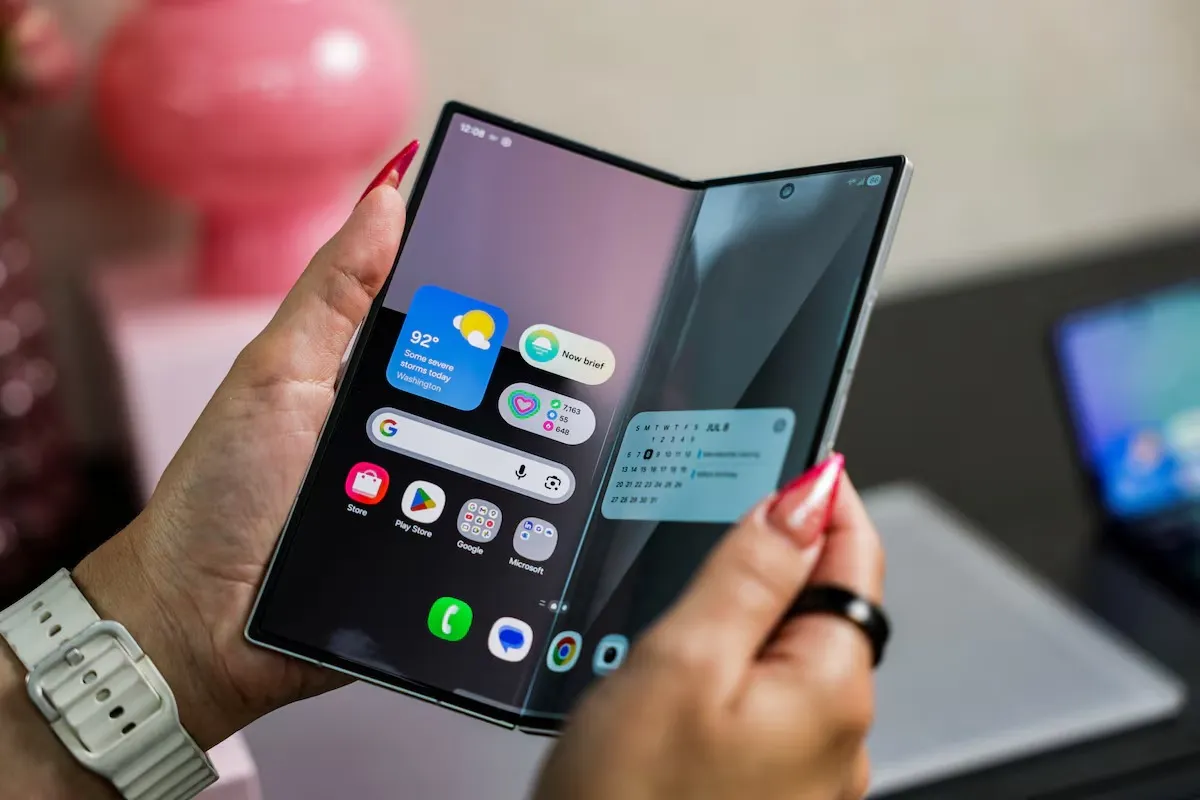
Seoul, South Korea – Samsung Electronics released its thinnest Galaxy Z Fold ever, the Galaxy Z Fold 7 – and the upgraded Z Flip 7, a turning point in its bid to regain leadership in the super-premium mobile market. But as the phones shrink in weight and size, critics caution that Samsung is essentially giving up on essential features in a rush for thinness to win customers, just when Chinese competitors and Apple are poised to close the gap in innovation.
What’s New with Fold 7 and Flip 7?
Samsung’s seventh-gen foldables arrive with significant enhancements from the inside out. At the time of initial hands-on reviews, Z Fold 7 was reportedly about 10% lighter and 26% thinner than its predecessor, with a folded thickness of just 8.9 mm and a weight of 215 g. The cover screen stretches to 6.5 inches, while the inside screen now grows to 8 inches. Under the cover, customers are getting a powerhouse Snapdragon 8 Elite chip, up to 16 GB of RAM, and a $1,999 price point: trying even premium consumers’ budgets.
The Z Flip 7, on the other hand, sacrifices bulk for a bigger 4.1-inch cover screen, a more substantial 4,300mAh battery, support for Samsung DeX and Google Gemini AI, and still only a slight decrease in folded thickness. The Z Flip 7 FE moves foldable tech to a more affordable $899 price point, but it’s up against serious competition from alternative budget foldables.
The Thinness Trade-Off
Although the thin form factor is eye-catching, at a cost. Most significantly, the Fold 7 sacrifices S Pen support, a key capability for heavy users, to lose 0.3 mm of display layers theverge.com. The selfie camera hidden beneath the screen also yields to an old-fashioned punch-hole lens – satisfying some consumers with improved photo clarity, but perhaps less futuristic.
Durable worries hang over. As reviewers point out, although Samsung boasts enhanced hinges, stronger frames, and Armor aluminum, thinness could mean thin protection. An examination by Light Reading points out that in spite of thinner frames, bulk is still a main problem hindering mass acceptance of foldables.
Coping with A Competitive Wildfire
Samsung’s previously unchallenged foldable lead is crumbling under pressure. In 2022, its global share of foldable shipments was 81%, down to about 63% in 2023 – with Canalys reporting further loss in 2024.
Huawei, Honor, Oppo, Xiaomi, and Vivo from China are inundating the market with high-feature, competitively priced foldables. Huawei alone shifted more than 4.2 million units in 2024, pointing to increasing dominance in its native market and beyond.
Bargainers note that Samsung’s pricing approach solid at close to $2,000 – is not as attractive, particularly since competitors provide similar or superior specs for a fraction of the price.
AI and Feature Differentiation
Samsung is counting on its incorporation of Galaxy AI and Google Gemini as a distinguishing factor. New features encompass “Circle to Search,” intelligent transcription and translation within Notes, Sketch-to-Image features, and some other intelligent utilities.
But there are doubts if software can make up for the sacrifices in hardware. Without the stylus, reduced charging speed, and constant battery capacity, experts are wondering if Samsung is offering genuine advancement or merely incremental adjustments.
The Price Paradox
That $1,999 price tag hangs heavy. Samsung rationalized the surcharge by pointing to increased R&D and component expenses, but foldables account for less than 1.5% of global smartphone shipments and so their mass appeal remains restricted.
Samsung is balancing price strategies with care. Rumors indicate that the Flip 7 could even be priced lower in Europe, whereas the Fold 7 would hold or incrementally increase pricing, experimented upon by market receptiveness.
User Experience and Durability
Durability is a key stumbling block. Consumer reviews point to concerns regarding crease visibility, dust entry, and brittle screens analyticsinsight.net. Such sentiment filters down to wariness, tempering excitement in mainstream markets.
Samsung has pushed back with heavier-duty hinges, Gorilla Glass Victus 2, and vapor-chamber cooling — but still missing industry-standard dust resistance, long-term reliability has not been tested.
Ahead: Tri-fold and Edge
Samsung’s pipeline goes beyond thinner foldables. They’re considering tri-fold types and the extremely thin Galaxy S25 Edge, to compete in fresh premium segments.
But with Apple poised to join the foldables game in 2026, Samsung’s opportunity to lock down leadership could be slipping away quickly.
The Galaxy Z Fold 7 is an engineering marvel: sleek, lighter, and wiser than ever before. But its higher price, removal of major features, and questionable longevity raise questions that remain unanswered:
Can thinner equals better for foldable phones?
Will buyers pay a $2,000 premium for incremental improvements?
And will Samsung be able to maintain the lead over swiftly rising Chinese competitors?
Samsung’s coming quarters will tell us if its bet on foldables pays off – or if competitors rewrite the rulebook.