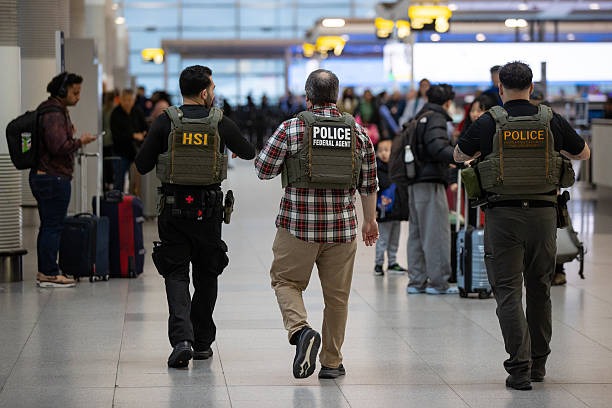
This week, millions of passengers found little has any such big effect in their transition to U. S. airports. There is an ever-so-slightly lengthier line, a tension that is slightly heightened, and in some terminals, TSA officers are now genteelly accompanied by different uniforms.
Down for its longest-running government shutdown, an apparent point has been reached in terminal staffing such that the federal government is now deploying Immigration and Customs Enforcement, or ICE, agents, to bolster the numbers in repressed airports across the nation. The policy increased the complexity of the otherwise predictable life that travelers had to deal with.
Stretched to Beyond Acceptable Limits
It is the Transportation Security Administration (TSA), the agency responsible for screening passengers and luggage at airports nationwide, that forms the heart of the malfunction.
With the government closure, thousands of TSA workers have been working without pay for weeks. The financial hardships kept increasing, and the rate of sick leave also surged. One day recently, nearly 12 percent of the TSA workers failed to show up for work. But major airports were witnessing far higher numbers of absentees.
Since the shutdown began, the results are out there for all to see.
At Hartsfield-Jackson Atlanta International Airport, the busiest airport in the United States, officials advised passengers to arrive up to four hours early as staffing shortages had generated severe delays that day.
Security lines have been extended throughout terminals in airports across the nation, passengers have been missing flights, and airport operations have traded their smooth flow for the semblance of managed chaos.
Why ICE Matters
In order to address the staffing crisis, the Department of Homeland Security has sent hundreds of ICE agents to airports in the cities of New York, Phoenix, New Orleans, and Atlanta.
It is worth repeating that these agents are not replacing the TSA officers responsible for the core functions of screening. Rather, the ICE personnel have come in to support the following:
- crowd and passenger flow management
- back up for ID-checking areas
- artificial smoothing of bottlenecks created by security lines
In other words, they are there for the purpose of lubricating the system, not for steering the wheel.
But the ICE agency is much more associated with enforcement; coming into the scene as the force of enforcement may create confusion among airport tourists.
The Question on Everybody’s Lips
But for a great many tourists, the first question is: Are ICE agents engaged in immigration enforcement at U. S. airports?
And the answer given is: No.
The federal and regional officials downplayed the concerns and stated repeatedly that ICE agents are there for operational augmentation and not for any enforcement actions.
Thus, the facts are not that simple.
Donald Trump has stated that he has given ICE agents the authority to execute immigration arrests anywhere if an exigency of such nature arises, notwithstanding that it might not be their chief mission
That interpretation is most pertinent now, maybe even more than it is distressing to immigrant communities and global travelers.
Despite such worry, for the majority of the ordinary clientele, nothing has changed: air service continues smoothly, planes take off, and the basic dynamics of air transport are maintained amidst distress.
What Travelers Must Know During the U. S. Shutdown
As we are to go to the airport, perhaps the most important thing, given the current situation, is the amount of time it will take us to get there.
Libby rulers advocate the passengers to:
- Arrive early, with 3 to 4 hours in advance being preferred by most
- Be prepared for very long and irregular wait times
- Ensure traveling documents are safely stored inside for quick checking of ID
- Keep your luggage packed and tight so that there are no delays on their way through the screening process.
With the flights largely running on time, the issue was the intense security checkpoint congestion.
“As an air traveler, I consider the security line to be the biggest variable at the airport,” says an aviation expert, but as the shutdown unfolds, this truth comes to light more and more with each day.
Growing Pressure on the Workforce
On the back end, deepened vulnerabilities in the airport security system have been laid out.
The TSA’s untimely mandate for essential worker status on unpaid leave means that the TSA is providing personnel to continue to provide security. However, no one is certain how long this can be maintained.
Since the shutdown began, more than 400 TSA employees have resigned, adding stress to an already stretched workforce.
The decision to syndicate ICE agents was met with backlash from labor unions, maintaining that they are inadequately trained in aviation security measures and hence pointed out potential dangers as a result.
Thus, it is a pressurized system, one that seems to work well, but, like anything that is vulnerable and frail, it may come backfire.
A Political Standoff with Real-Life Consequences
The airport upheavals are but a very public result of a paramount political conflict deeply rooted in Washington DC.
The shutdown itself also follows a deadlock over funding Homeland Security, with disagreement over immigration policy and the role of definitely-strained law enforcement institutions such as ICE.
The result is that where the negotiations come to a standstill—Washington, DC—picking up the slack right away are the terminals where the travellers, airline staff, and security officers must grapple with their ramifications.
The Psychology of Travel While in Turbulent Times
Traveling has always demanded good amounts of patience.
What acutely weighs at the moment is ambiguity.
The multitude of lines that give access to security checkpoints come with an added burden of stepping into a strange environment; only few workers in place of the usual many; altered processing systems; and always dealing with the uncertainty as to how long this will go on for.
As changes become noticeable to the chronic traveler, the unredeemed bear time at the airport may be disorienting.
Despite the confusion, the one thing that remains tentative remains the very fact that even after all the strain, the wheels of motion do gradually turn.
This Is Settled, for Now.
Should ICE agents ever become a regular fixture at airport hold-down operations depend entirely on how long this shutdown lasts.
Should there be an awakening that restores funding, TSA staffing levels will be on the mend, and reliance on external manpower may vanish.
If the impasse continues, this system might stay in place unsupervised, but further creation of more such arrangements cannot be ruled out
At the moment, travelers are left to negotiate conditions as they find them: show up earlier, be patient, and bull through the system that somehow seems to still be holding it together.
And past the bulk of TSA agents, ICE agents and all those lines inching forward are also reminded as they walk through security that even typical journeys can be influenced by forces that originate from far beyond the airport.