
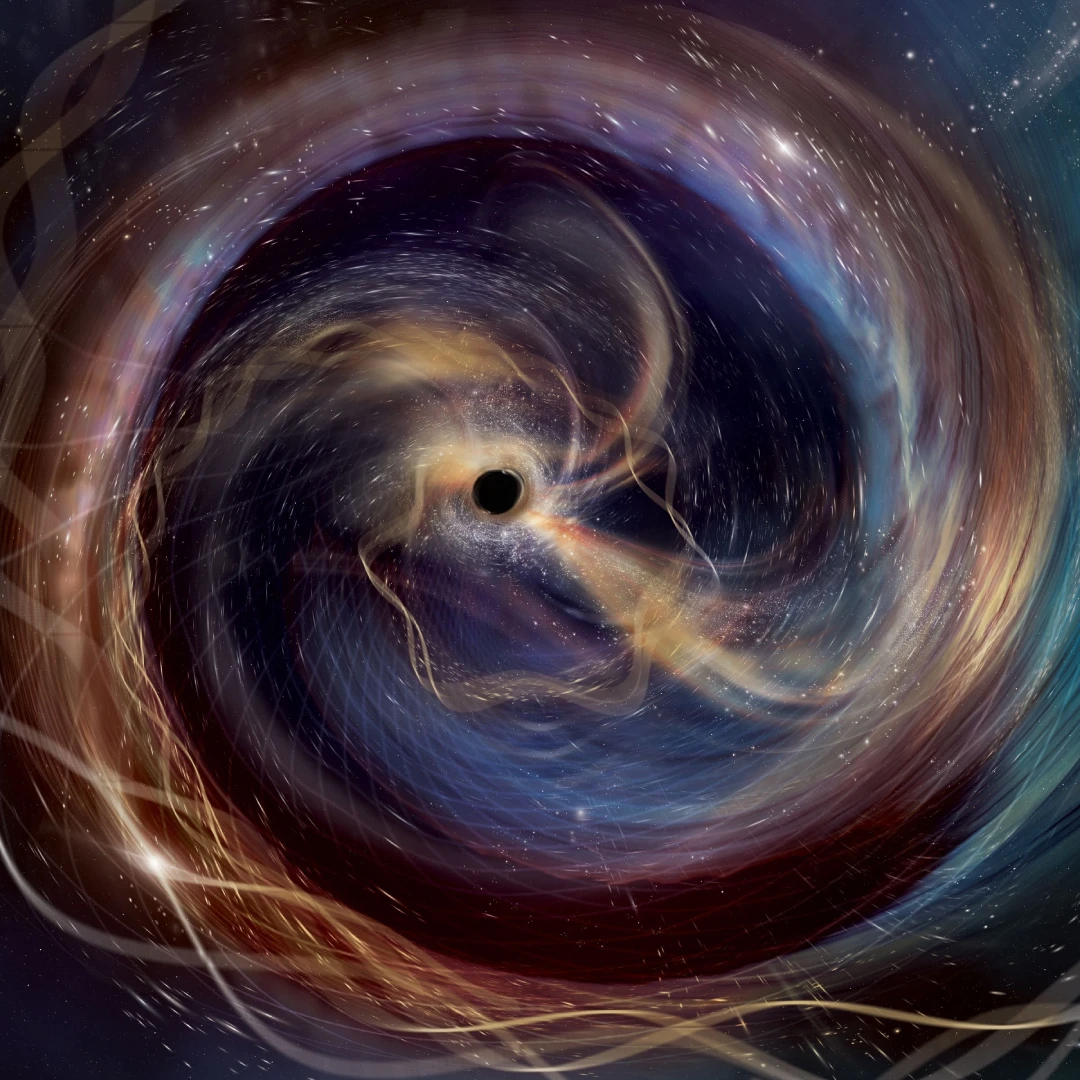
There are not many places in the universe where the rules of physics are challenged as intensely as when two black holes start colliding.
These objects, among the most extreme things science knows, have gravitational fields so powerful that once light passes their limits it cannot get back out. Still, when two black holes spiral inward and then merge at last, they create ripples in the fabric of spacetime itself, kind of like waves that can move across billions of light-years before they even show up here on Earth.
Researchers have now used one of these unbelievable cosmic mergers to examine predictions that go back decades. In doing so they offer another clear verification of ideas tied to Albert Einstein and Stephen Hawking.
The result is significant not simply because it includes black holes, but also because it shows how observations made with instruments here on Earth can reach some of the furthest, most stubborn predictions people have ever tried to test about gravity, spacetime, and the character of these strange objects
Listening to the Universe
For most of human history, astronomers studied the universe mostly through light.
Telescopes watched visible light, radio waves, X-rays, and other kinds of electromagnetic radiation. Black holes posed an obvious snag, because by their whole design, they do not permit light to get out from inside their event horizons.
That changed once gravitational wave astronomy started to take shape
In 2015, scientists detected gravitational waves for the very first time, which confirmed a major prediction from Einstein’s general theory of relativity, that had been made a hundred years earlier. These waves came from the merger of two black holes, and in doing so they opened a fresh way of observing the cosmos.
Instead of just looking at the universe, scientists can now listen to it, a bit like you can hear the atmosphere. Facilities like the Laser Interferometer Gravitational-Wave Observatory, or LIGO, together with Virgo and KAGRA have since found a bunch of mergers that involve black holes and neutron stars.
Every single event is like a fresh experiment in extreme gravity, not the usual lab at all.
A Cosmic Test of Einstein
Einstein’s general theory of relativity explains gravity not only as a force, but as a bending of spacetime driven by mass and energy.
Close to black holes, that spacetime distortion gets remarkably strong.
The theory says that when two black holes combine, the new remnant should “ring” the way a struck bell does. The gravitational waves emitted during this stage carry clues about the characteristics of the final black hole.
Researchers then examine the wave tones and how fast they fade, to see whether the newly formed black hole behaves the way general relativity forecasts.
This is where the recent result, starts to get really interesting, kind of.
The observations let researchers look at the black hole’s so-called ringdown phase, the period right after the merger, when the newly formed black hole settles down into a stable state, again.
Per Einstein’s theory, the frequencies of this “ringing” should connect back to the black hole’s mass and spin.
If the measurements had shown surprise frequencies, or a weird decay behavior, it could have suggested that general relativity fails when conditions become extremely harsh.
But instead, the data keeps lining up with the theory.
Hawking’s Black Hole Prediction
Einstein is not the only famous physicist, whose thinking matters here.
Stephen Hawking reshaped our view of black holes in the 1970s, by proposing that they are not completely dark.
According to Hawking’s calculations, quantum effects just around a black hole’s event horizon should let black holes leak extremely faint radiation, now known as Hawking radiation.
His work also produced a deep prediction about black-hole entropy, and how a black hole’s event-horizon surface area is tied to how much information it can hold.
The link between Hawking’s ideas and gravitational-wave observations is subtle, but it matters.
When two black holes merge, the total area of their event horizons should not go down, at least not under the classical physics described by general relativity.
This statement is closely connected with Hawking’s area theorem.
In plain terms, the combined surface area of the event horizons before the merger should be less than or equal to the surface area of the final black hole.
The newest observations give another chance to test this prediction.
The Black Hole Area Theorem
The idea sounds straightforward, but testing it is anything but, honestly.
Scientists need to piece together the characteristics of the two original black holes from gravitational-wave signals and then put those findings alongside the traits of the last merged object, to see if it matches.
Since the event happened incredibly far away, researchers cannot, observe the black holes directly.
What they can do is examine the minute distortions in spacetime, that are captured by detectors on Earth.
Those computations are beyond demanding.
Still, the outcomes have kept coming back showing that the merger behaves in line with Hawking’s area theorem.
It’s another instance where theoretical physics that was drafted on paper decades ago can later be checked against actual happenings in the cosmos.
Why the Result Matters
Science does not move forward by verifying one theory just once.
Each black-hole merger offers another chance to look for departures, from Einstein’s expectations.
This part matters even more because physicists already notice that general relativity and quantum mechanics, in their current shapes, do not sit together comfortably.
General relativity describes gravity and huge scale structures in a remarkably solid way.
Quantum mechanics, meanwhile, is what steers the microscopic realm.
Black holes then show up right where those ideas feel like they clash, a little uncomfortably.
If we can understand them, maybe we will learn exactly where the present frameworks need to be expanded, or even exchanged.
Because of that, researchers are not only trying to get confirmation.
They’re actually hunting for weak spots, quiet inconsistencies.
Until now, black holes have stayed stubbornly aligned with Einstein.
A New Era of Gravitational Astronomy
The number of gravitational-wave detections keeps growing and that is reshaping astronomy.
Every merger, when studied carefully, provides clues about black hole demographics, stellar evolution pathways, galaxy growth, and how gravity behaves when conditions become extreme.
In the future, new observatories should deliver measurements that are more precise still.
The planned space-based Laser Interferometer Space Antenna, also known as LISA, might detect gravitational waves from places that are beyond reach for current ground instruments.
Over time these measurements could help scientists probe gravity across an even wider mix of settings.
The Universe as a Laboratory
One of the most striking aspects of all this is the sheer scale.
The collision likely took place billions of years ago, long before humans were around.
The black holes themselves may have arisen from stars that lived and ended in remote galaxies.
Their last coalescence released a tremendous quantity of energy as gravitational waves.
Those waves traveled through the cosmos.
Then at some point they passed through Earth.
Ultra-sensitive instruments noticed a tiny wobble in spacetime and from that, researchers could infer a ferocious episode that happened beyond imagination far away.
It is hard to picture a more dramatic test bench.
The Questions That Remain
Confirmation is not really the end of the story.
If anything, every successful check of general relativity makes the open, unanswered puzzles more puzzling and maybe more attractive.
So, what happens inside a black hole?
Also, what do we see ultimately with the information that slips past the event horizon, and then is it lost for good or just rearranged somehow?
How does gravity behave down at the quantum level, where everything gets more delicate?
And can future observations reveal faint shifts, departures from Einstein equation(s)?
For now, the universe keeps giving an astonishing kind of reply to one of science’s long-running questions: do our theories, in fact, mirror reality?
With every black hole collision, researchers get another shot to probe this.
And once again, the cosmos looks like it is telling us that Einstein, and in a related way Hawking, were already remarkably close to the truth.