
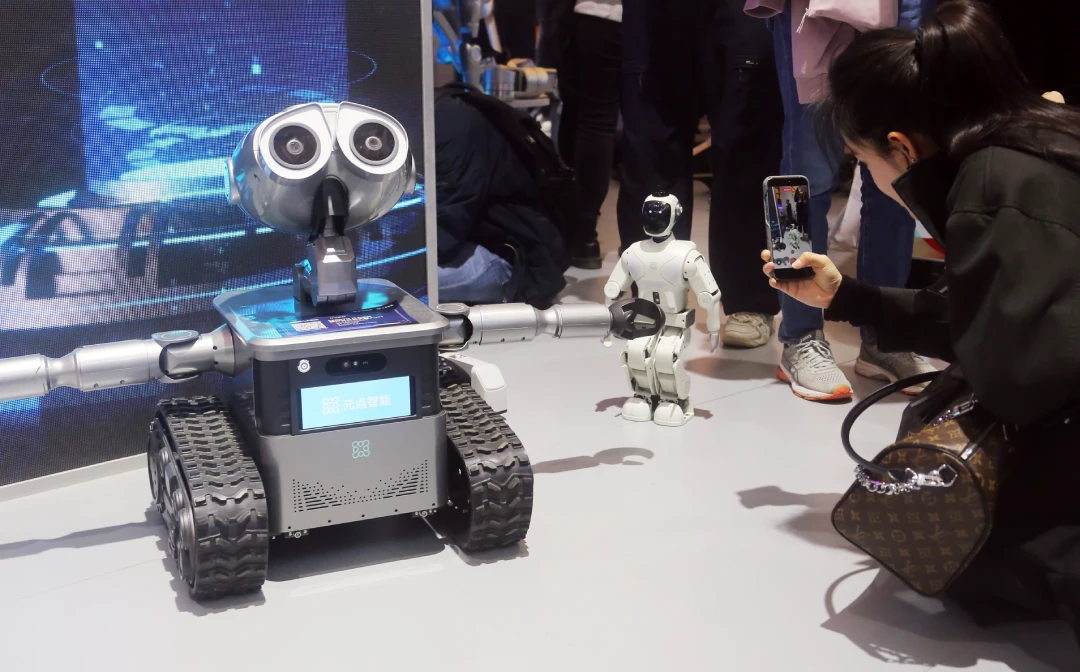
Artificial intelligence has been on the front pages for the past two years, yet another technological revolution is moving forward in the background, one that may change how people work, produce items, and relate to machines.
At the middle of this growing contest is Ant Group, the fintech heavyweight supported by Alibaba Group, which has been increasing its bets on humanoid robotics. In the last 18 months, the company has reportedly made roughly a dozen partnerships and investment agreements tied to robotics, and it points to one of the more aggressive pushes by a Chinese tech firm into what many analysts think could become the next trillion-dollar field.
For a company best known for digital payments and financial technology, the move may seem unexpected. But under the surface, Ant Group’s strategy is showing a bigger change happening across China’s technology sector, one where artificial intelligence is no longer stuck in software, and is instead increasingly embodied in physical machines.
Beyond Financial Technology
For years, Ant Group has built its name through digital finance.
Its key payment platform has built Alipay, changed how mobile payments work in China, and become one of the world’s largest digital financial ecosystems. Later on, the company also pushed into wealth management, insurance technology, cloud computing, and AI-led financial services.
Now, Ant looks set on diversifying even further.
Instead of competing only in digital services, the company is putting resources into the physical deployment of artificial intelligence via humanoid robots, machines designed to carry out tasks in spaces that are built for people.
Unlike industrial robots that repeat fixed motions inside factories, humanoid robots are meant to roam around offices, warehouses, hospitals, retail stores, and even homes.
The tech is still in its early stages, but industry leaders keep saying it could be the next frontier for AI.
Why Humanoid Robots?
The new interest in humanoid robotics is coming from a few trends that line up together.
Rapid progress in generative AI has boosted robots’ ability to understand language, read their surroundings, and choose actions in real time.
Meanwhile, lower hardware costs, better sensors, more efficient batteries, and computer vision systems that are getting more capable have made the idea of commercial humanoid robots feel more realistic than before.
China also has demographic pressures.
An aging population and slower workforce growth have raised the need for automation across manufacturing, logistics, healthcare, and elder care.
Humanoid robots might provide a potential way forward, mostly because they can work inside existing spaces made for people without needing all-new infrastructure, or at least not as much.
Instead of having to redesign factories or hospitals for robots, engineers are aiming for machines that can adapt to areas that are already in place, built for human routines.
Building an Ecosystem, Not Just Products
One interesting part of Ant Group’s approach is how it leans on partnerships instead of trying to manufacture every single piece on its own.
After doing around a dozen investments and collaborations over just 18 months, the company seems focused on putting together a broader robotics ecosystem, not merely a set of standalone products.
These relationships are said to cover robot manufacturers, embodied AI developers, motion control specialists, simulation software providers, and even component suppliers.
Instead of placing one big bet on a single technical track, Ant is spreading its investments across the robotics value chain, step by step and layer by layer.
This approach looks like the methods used earlier in cloud computing and in artificial intelligence, where big tech companies often throw money in many directions first, before they can clearly spot the long-term winners later.
China’s Growing Robotics Race
Ant Group is definitely not the only one.
All across China, huge technology firms together with smaller startups are putting billions into robotics R&D, and they are doing it fast.
Firms like Unitree Robotics, UBTECH Robotics, AgiBot, and Fourier Intelligence are rolling out more and more advanced humanoid machines that can walk stably, handle everyday items, take voice requests, and then complete basic tasks around the workplace.
On top of that, support from the government has sped everything up.
Beijing has named advanced robotics as a priority strategic industry, seeing automation as necessary for keeping manufacturing competitive, and also for dealing with longer term gaps in labor.
This mix of private capital and public policy has put China among the most active markets for humanoid robot development, in a very visible way, lately.
AI steps into the physical world
Industry experts sometimes describe the current robotics boom as the rise of “embodied AI”, but it is more than a marketing phrase.
Unlike older AI systems that live fully inside computers or on smartphones, embodied AI lets artificial intelligence move through and respond to the physical environment.
That shift creates an entirely different kind of engineering challenge, because it is not only computation, it is feedback, timing, and control.
A chatbot only has to generate language, and you can evaluate it at leisure.
A humanoid robot has to do many things at once, it needs to sense what is around it, keep balance, move its limbs to handle objects, find its way through unpredictable spaces, and also guard human safety while still making split-second decisions.
That complexity is one reason companies like Ant are investing across multiple disciplines, not just leaning on software expertise alone.
Commercial reality still lies ahead
Even with growing excitement, a full-scale rollout still feels like it’s several years away, maybe more.
For now, most humanoid robots are still costly prototypes or early commercial offerings, and that gap hasn’t really shrunk enough.
Battery limitations, movement efficiency, hardware durability, and safety certification still keep showing up as major engineering obstacles.
A lot of analysts believe the first truly commercially successful uses will appear in logistics, warehouse routines, manufacturing assistance, and industrial inspection more than in domestic households.
In those orderly settings, robots can handle repetitive or physically demanding work while sharing space with human workers.
Consumer adoption, by contrast, is likely to drag on for a lot longer.
Global competition is also getting sharper
Ant Group’s push also seems tied to intensifying worldwide rivalry.
In the United States, players like Tesla, Figure AI, Agility Robotics, Boston Dynamics, and Apptronik are driving similar ambitions.
Europe, Japan, and South Korea still keep putting big money into advanced robotics, as well.
So you get this fast-growing global hustle to commercialize humanoid machines.
And compared with earlier waves of industrial automation, the current contest is about mixing strong AI models with more advanced robotics hardware, which means the wins depend on having skills in software, mechanics, cloud computing, semiconductors, and data.
More Than a Robotics Stor
Ant Group’s move ends up sharing a bigger narrative about how technology keeps evolving.
For years and years, digital progress basically lived on screens.
Then the smartphone revolution changed the way people communicate.
After that, cloud computing reshaped how businesses operate.
Generative AI then reworked software creation.
Now, artificial intelligence is set to step off the screen entirely.
If today’s investments land properly, the next generation of AI assistants might not just reply through apps.
They might walk alongside warehouse workers, help nurses in hospitals, fill retail shelves, or guide elderly individuals through daily life at their homes.
Whether that future shows up in five years or fifteen remains up in the air, honestly.
What seems more and more obvious, though, is that Ant Group plans to take a major part in shaping it.
The dozen robotics deals from the last 18 months imply that one of China’s biggest technology companies no longer treats artificial intelligence as only something that thinks.
It views AI as something that moves.