
Some poetry asks readers to admire language. Other poetry asks them to understand emotion. Angel Santos’ Instar asks something far more demanding, it invites readers to witness transformation itself, even when that feels unfamiliar.
In an era where books often chase immediacy, spectacle, or easy interpretation, Instar drifts the other way. It leans into patience; it leans into process. Like the biological term it borrows for its title, the collection stays with the unnoticed step between beginnings and endings, that quiet in-between where growth keeps happening, you just do not see it directly.
What arises feels like more than just a poetry collection. It reads as a philosophical autobiography rendered through metaphor, it becomes a visual artist’s gallery translated into verse, and it turns into a scientist’s long-ago curiosity about transformation, expressed in language. Every page shows that Santos has spent decades looking at not only biology, literature, and art, but also the slow shifting of the human soul.

When a Box of Crayons Exploded
Some childhood memories fade into fragments, and he still doesn’t understand why.
Angel Santos remembers colors. Not only the colors themselves, but the way they showed up, collided, and kept changing his imagination after that.
When he grew up in Puerto Rico, he recalls an aqua-green wooden house lifted a bit above the ground, where chickens waited for cover under the floorboards. Family gatherings felt musical, because music was simply part of Puerto Rican life. Instead of carrying a security blanket as a child, Santos carried a vinyl record, spinning it on his finger while he sang made-up songs under his breath.
Creativity was not something that was introduced to him. It was already there before he even knew what that word meant.
He would break marbles apart just to see how colors became captured inside glass. His grandmothers made reading into a playful hunt rather than a chore, bringing in those refined “Sunday words” that nudged curiosity forward, not memorization.
Still, there was one moment that stayed, permanently etched into his imagination.
When he was seven, while digging clams next to his father, the dawn sky shimmered over black sand. Then, out of nowhere, a nearby hippie commune appeared, dancing bare to Aquarius, Let the Sunshine In. Flowers, scarves, movement, music, sunrise, ocean reflections everything seemed to converge, into the kind of scene Santos still tries to describe as the moment his imagination woke up.
Later his father asked if that weird gathering had touched him in some way.
Santos’ answer, which he never forgets, became, maybe without intention, the origin story of Instar.
“What happened is that my box of crayons exploded.”
It is one of those rare childhood remarks that ends up explaining an entire artistic life.
Growing Up Between Science and Imagination
Many writers eventually choose between scientific precision and artistic freedom.
Angel Santos never accepted that division.
His childhood encyclopedias fascinated him as much as fairy tales. Science fiction occupied the same mental space as biology. Catholic churches simultaneously inspired awe and fear through hyper-realistic religious sculptures whose glass eyes seemed almost alive. Action figures became actors inside handmade cardboard landscapes. His father shaped metal through welding. One grandmother designed bridal gowns. Another preserved culinary tradition inherited from Danish ancestry. An aunt sewed clothing. A cousin drew.
Creativity surrounded him in practical forms long before it became artistic expression.
Later, university professors recognized abilities Santos himself had not fully acknowledged. They noticed that even his examinations sounded unlike those of ordinary students. One professor returned a literature exam with a single word. “Poet.”
He protested.
He knew classical poetry. He knew meter. He knew he wasn’t writing like traditional poets. Her answer changed everything. “You speak in free verse.”
The following years validated her observation.
In 1987 Santos earned Third Prize in a university literary competition for short fiction. A year later he returned – not with another story – but with poetry. This time he won First Prize. Recognition mattered. Publication mattered. But perhaps more important was permission. Permission to believe that his voice already existed.
The Scientist Who Never Left the Artist Behind
Instar is at its best when it won’t treat science and art as enemies, as if they share no air to breathe. To Santos, it has always felt like one ongoing language, just with different vocabularies, like the same thought speaking through slightly different mouths.
His path, started in biological sciences, taught him observation, patience, precision, and an honest respect for process, not the flashy kind. Scientific illustration then made the artistic side steadier, more disciplined. And when he drew anatomical structures, his attention kept tightening. Writing poetry did something similar, it sharpened his perception in another direction.
Those two disciplines keep feeding each other, all the way through. In fact, in the interview he keeps coming back to a deep belief that sounds simple but keeps unfolding: everything is design, everything belongs together. Humans drew before they wrote. Images turned into symbols. Symbols turned into language. Language turned into civilization.
You can feel that philosophy on every page of Instar. The scientific terminology is not there as intellectual window dressing. Instead, biological concepts act like emotional metaphors, close enough to touch. Transformation is not only described. It is understood anatomically, in the body of the work itself.
A Literary Journey Built Across Decades
While Instar marks Angel Santos’ first individual published poetry collection, the book represents the culmination of nearly four decades of literary growth, recognition, and artistic perseverance. Long before the collection reached readers, Santos had already begun building a quiet but meaningful presence within literary circles, earning awards, publication credits, and opportunities that steadily affirmed the distinctiveness of his voice.
His journey began in 1987, when his short story “Planeta Silencio” earned First Prize in the Literary Contest at Universidad Metropolitana. The achievement led to its publication in Mairena Magazine of the University of Puerto Rico, placing the work of a young sophomore alongside respected writers and educators.
The following year, 1988, Santos once again distinguished himself, this time receiving First Prize in the Poetry Category of the Universidad Metropolitana Literary Collective for “Es La Guerra.” The recognition confirmed what his professors had already begun to see: a writer whose poetic voice was emerging with uncommon originality.
Between 1989 and 1996, Santos devoted himself to writing and collecting poetry that would eventually shape the philosophical foundation of his future work. That dedication culminated in 1996 with the publication of “La Maquinaria de una Vida” (Machinery of a Life) in ENTRE NOUS Quarterly Journal in San Juan, Puerto Rico. The poem continued its artistic journey the following year when it was adapted as a dramatic performance during Cosecha – Theater Festival presented by Maskhunt, Inc., demonstrating the versatility of his writing beyond the printed page.
His literary reflections also extended beyond poetry itself. In 2010, Santos contributed the article “Why Do I Write Poetry?” to Orange Arts Magazine in London, offering readers insight into the creative philosophy that continues to shape his work today.
The publication of Instar in 2018 became a defining milestone as his first standalone poetry collection, but it was by no means the conclusion of his artistic evolution. Recognition continued internationally. In 2023, his poem “Anthropos” was selected as a winner by #indiepoetryplease in London, further establishing his voice within contemporary independent poetry.
The following year proved especially significant. His poem “Remains” appeared in Dear Survivor: Reclaim the Light, an anthology published by Beyond the Veil Press, while “Fantasy 2 (Flight and Conquer)” was selected for inclusion in the Florida Bards Poetry Anthology 2024. Instar itself reached an even broader audience when it was presented at the 2024 American Library Association (ALA) Annual Conference & Exhibition in San Diego, California, introducing the collection to librarians, educators, and literary professionals from across the country.
Also in 2024, his poem “The Undercover” found a home in Ghosts, Echoes & Shadows, an anthology published by Local Gems in New York, further demonstrating the breadth of his creative range and his continued presence within contemporary poetry.
True to the central message of Instar, Santos views artistic growth as a continual process rather than a finished achievement. That philosophy is already guiding his next literary endeavor. He is currently developing his second book, Lambs, Seals, Horns, a work in progress that promises to continue exploring the rich intersections of spirituality, symbolism, science, and human transformation that have become hallmarks of his writing.
Why “Instar” Is the Perfect Title
Plenty of readers recognize, butterfly metamorphosis. But fewer notice the scientific term instar.
An instar is the developmental phase that sits between molts.
It is not quite a start, not quite a finish. It is growth itself, right there. Feeding. Changing. Quietly rehearsing. Invisible development, the stuff you miss.
Santos intentionally turned away from the easier title “Metamorphosis.”
Too many books had already used it. His scientific education wanted precision, full stop. His artistic sense also wanted symbolism, no compromise.
What comes out is strangely powerful. That overlooked stage becomes a central metaphor for how people are.
Some people celebrate success. Others spend time grieving endings. Few give much attention to process. Even so, process fills almost all of life. This idea pushes Instar beyond a personal memoir, into something like universal meditation.
We keep dropping emotional exoskeletons.
Childhood, fear. Depression, old roles. Outdated beliefs, and other worn labels.
And every shift, every transformation, needs an instar.
Depression as a Different Kind of Molting
Maybe the book’s most emotionally resonant foundation comes from Santos’ willingness to talk about depression, straight up, without avoiding it.
He does not dress up suffering in pretty language. And he does not shrink healing into motivational slogans. Rather, he lays out what survival looks like with a surprising level of candor.
Years of living in a survival mode, kept stacking until depression became severe. At a certain point, even basic functionality started to slip. So, he asked for professional help.

That choice shifted more than just his mental health; it also reshaped his creative future. Funny enough, the therapists ended up being some of his strongest believers. They pushed him to trust the gift he had been doubting for years.
Instar was not born in spite of vulnerability. It arrived because vulnerability was finally recognized as real, and not something to hide. That directness gives the collection emotional credibility. Readers feel like they are not being served carefully manufactured inspiration. They are seeing authentic recovery unfold.
Puerto Rico Lives Inside Every Page
Although Instar is bilingual, Santos never abandons his Puerto Rican identity.
Instead, he expands it.
He explains that much of Latin America naturally embraces magical realism because reality itself has always contained multiple cultural worlds. Puerto Rico embodies indigenous Taíno traditions. Spanish colonial influence. African heritage. Catholic symbolism. Religious syncretism. Music. Dance. Folklore. These influences naturally shape imagination. His poetry frequently incorporates Puerto Rican expressions, culinary references, folklore, and cultural symbols.
Words like Mundillo and Vejigante remain intentionally rooted in their original language. Translation, Santos believes, should expand understanding rather than erase identity. His English poems therefore become reinterpretations rather than literal translations. Even after two decades living in the continental United States, he still dreams in Spanish. That simple admission explains why his bilingual writing possesses unusual emotional texture. Readers are experiencing not merely translated language. They are experiencing translated consciousness.
The Visual Poet
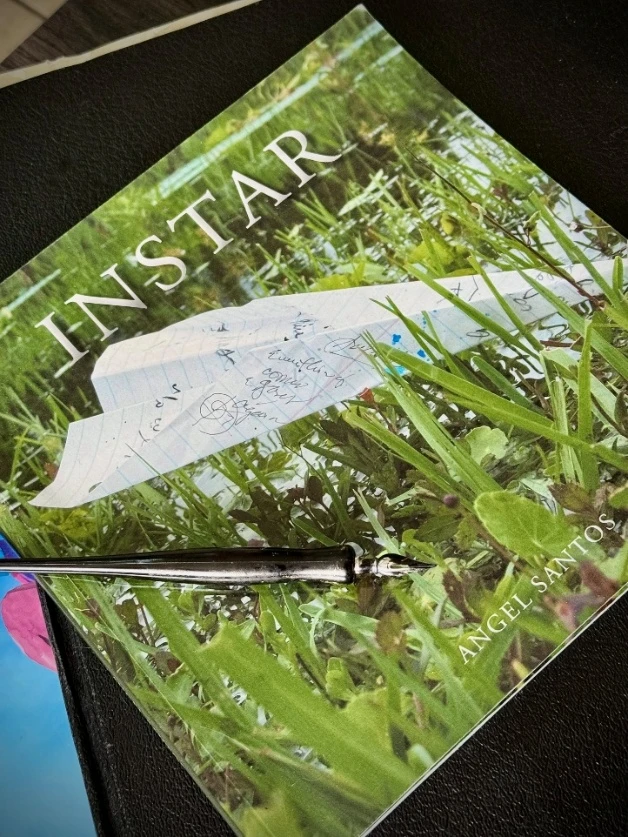
Reading Instar often feels, a bit weirdly, cinematic. And no, that is hardly accidental. Angel Santos studied Animation Art & Design, alongside Motion Graphics and visual effects too. He went ahead and designed the book’s cover himself. Then he made the illustrations.
After that, he formatted the eBook as well.
All those artistic disciplines come together inside every single piece of the publication, even in the small margins. And more than that, Santos writes the way someone paints. You notice, the images arrive before any real explanation does. Dream logic shows up before a plain literal reading can settle in. Reality keeps bending, again and again, yet it never actually breaks.
His poems feel like surrealist canvases where symbolic objects trade quiet messages, truths that ordinary wording can’t quite reach. He calls it “blending worlds.” Honestly, it fits too well. Instead of escaping reality, his surreal imagery deepens it.
Symbolism as Universal Language
Santos keeps coming back to symbolism, like in both his interview and also his poetry, you know, it shows up again and again. To him, symbolism is humanity’s oldest dictionary, just there, before anything else. Before alphabets even existed, humans were speaking through images and visual representation, even if it was limited. Modern emojis, they keep the same tradition going, even now. So, his paintings start acting like messages, almost like they are delivered directly. And his poems turn into visual landscapes, where the meaning can be seen, not only read.
Neither field really stands alone, not in his mind. Every artistic choice includes intention, even when it feels quiet. Every metaphor becomes communication, not decoration. And his own first name becomes symbolic, too, he treats it like a sign rather than a label.
“Angel” he explains, means messenger. Bringing messages, he believes, is his true-life task. You can feel that Instar fulfills exactly that calling.
A Book That Refuses Easy Answers
People looking for straightforward autobiographical poetry might find Instar a little challenging at first. The dreamlike arrangement asks for your participation, not just a passive read. Its symbolism feels like it is meant for interpretation, not for a tidy final answer, ever. Even the scientific references seem to pay off if you keep poking around with curiosity. And the spiritual side stays open minded, not doctrinal or tightly defined. That openness ends up being one of the collection’s biggest assets. Santos does not push a single meaning on you.
Instead, he lets readers see their own reflections inside his metaphors, the way light catches glass. And as he hopes for too, you may later recognize your own transformations inside these poems. In the end that aim turns literature into an actual back and forth conversation, not a one-way performance.
A Critical Review
From a literary standpoint, Instar works because it has a sort of conceptual unity while also not losing its emotional reach.
The biological metaphor keeps showing up in a coherent way across the whole collection, and it stays genuinely persuasive.
The bilingual presentation broadens access for more people, but it still holds on to what feels authentic.
Its main win is in how it weaves together things that seem incompatible at first glance.
Science,
Poetry,
Visual art,
Spiritual reflection,
Psychology,
Puerto Rican cultural identity.
Instead of pushing back against each other, these parts tend to deepen the effect, they add to each other.
There are a few places where readers who are not used to surrealist or symbolic poetry might feel they want more straightforward narrative clarity. Still asking for exact literal explanation misses what the collection is trying to do. Dreams usually do not explain themselves. Neither does transformation.
Instead, Santos invites readers to live inside the uncertainty long enough, until meaning rises up on its own. And yes, that patience pays off if you read carefully.
The Legacy of Continuous Becoming
Maybe the most lasting notion Angel Santos brings forward is that transformation never really finishes, not even when you think it should. Molting does not finish the work; it just keeps going. Growth keeps stretching, and learning goes on until the last breath of life. Even death, he says, still hands out one final instruction How to let go.
It is a quiet, almost stubbornly humble philosophy from a creator whose gifts move through literature, painting animation, scientific illustration, biology, and a bilingual way of speaking. For all his decades of recognition, Santos keeps repeating that he knows very little.
He brings up Socrates. “I only know that I know nothing.” That kind of intellectual humility becomes the emotional pulse of Instar. It nudges people away from chasing perfection. And toward motion.
Growth.
Process.
Another instar.
Another transformation.
Another shedding, of the soul.
A Book That Leaves Its Mark
Angel Santos has made something, genuinely uncommon, almost like it was misplaced then found again.
Instar is not just a poetry collection, no. it’s more like an interdisciplinary kind of rumination on becoming fully human, and it does that without sounding like a lecture.
He pulls from biology, surrealism, Puerto Rican cultural identity, and visual symbolism, plus spirituality, plus the sort of personal events you can’t really fake. Santos keeps reminding you that the biggest life changes rarely show up at the “big day.” They slip in quietly, invisibly, in that small, unannounced space between one version of yourself and the next.
If you like poets like Pablo Neruda, Federico García Lorca, Octavio Paz, Mary Oliver, or maybe you lean toward the reflective interiority you find in Franz Kafka’s prose, then Instar will feel like a distinct companion. It’s introspective without getting overly sentimental, smart without acting superior, and symbolic without turning everything sealed shut for anyone who actually wants to think with it.
And in the end, Angel Santos leaves you with a truth that stays, even after the last page, we’re never really “done” becoming. Like the insects that inspired the title, we keep moving through unseen stages of growth, collecting lessons, letting go of older labels, and preparing for the next emergence.
By honoring that overlooked in-between, between what was and what will be, Instar manages to do what the best poetry always tries to do. It teaches you how to look at yourself more clearly, even when you don’t know you needed it.
For Angel Santos, creativity isn’t merely an artistic hobby, it’s a way of breathing. And with Instar, he doesn’t just hand readers something to read. He offers a transformation you’re meant to live through, bit by bit.
Explore more
Available through Amazon:
https://www.amazon.com/Instar-Angel-Santos/dp/1546237585
Author Information:
https://www.thriftbooks.com/a/angel-santos/1735812/
Official Website:
https://theinstar.com/