
A Life Formed by Faith
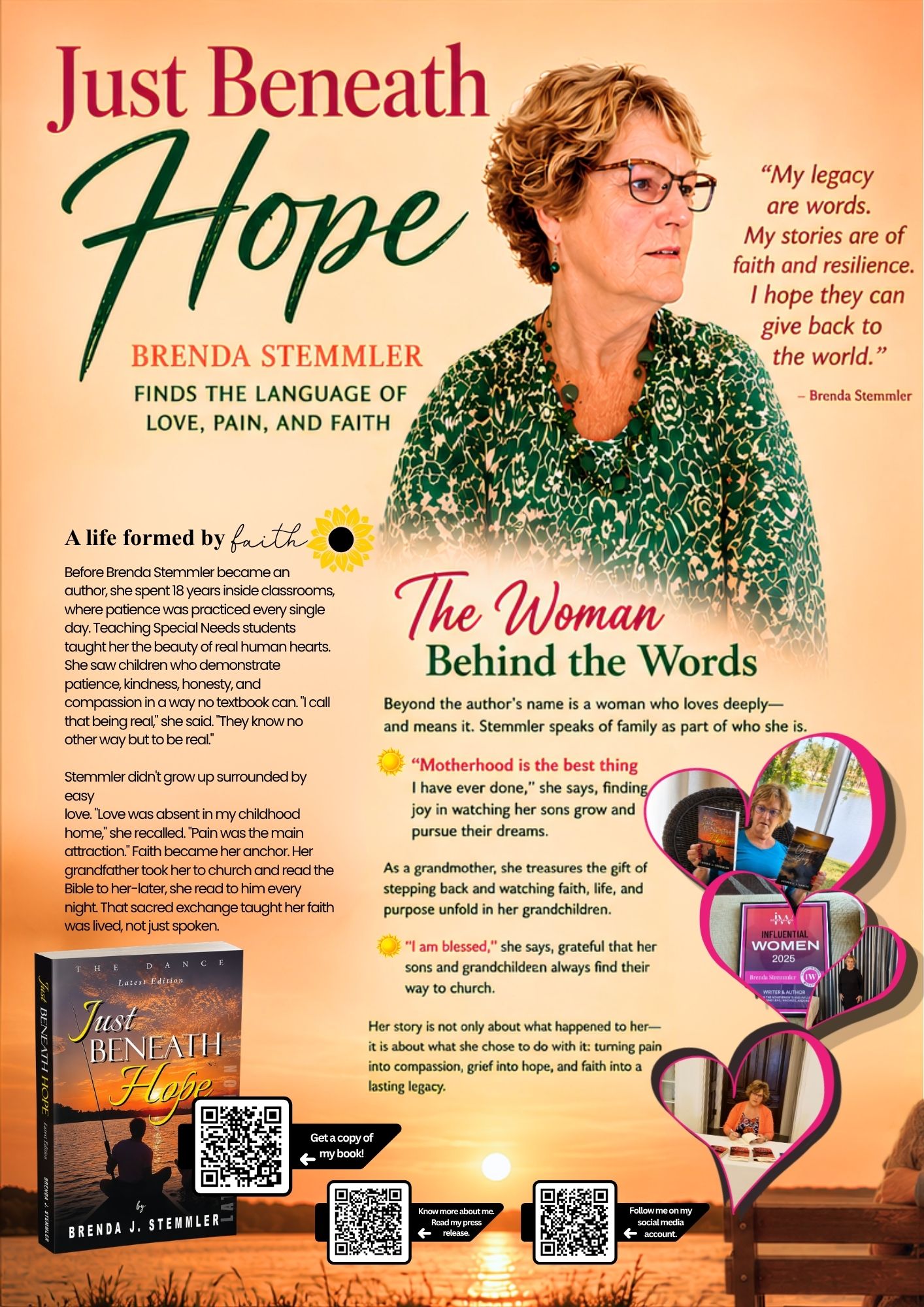
Before Brenda Stemmler became an author, before her words made it into books, poetry, and into the hearts of readers, she spent 18 years inside classrooms, where patience was not really a item in the lesson plan but more like something you practice every single day. She taught Special Needs students, with degrees in Special Needs and Elementary Education, and in that time she learned, maybe even more than she taught, how human beings reveal the truth when they are met with kindness.
For Stemmler, teaching was never only a profession. It was a gift. It held her faith steady, and it showed her what she calls “God’s handy work in the world.” In the faces and everyday lives of her students, she noticed something many people glance past. She saw children who demonstrate patience, kindness honesty, and compassion in a way no textbook really can. “I call that being real, ” she said. “They know no other way but to be real.”

That belief, that life in its purest state is often revealed through hardship, imperfection, and vulnerability, weaves through her work as a writer, and then spills right into her own day to day.
Stemmler did not grow up where easy affection sat around the room. “Love was absent in my childhood home,” she recalled. “Pain was the main attraction.” She came from what she called a very dysfunctional family, and faith became the rope she kept holding while trying to make sense of life. It was her grandfather, more than her mother or grandmother, who formed her early spiritual backbone. He took her to church. He read the Bible to her, and when he could no longer read , she read the Bible to him every night.
That swapping, simple and sacred, became part of the root system of her life. It taught her faith was not only a thing spoken on Sunday. It was something carried, traded, and practiced.
The Teacher Who Became a Writer
Stemmler did not always know she was a writer, like really know. In college, during an Honors English class, one of her professors pulled her aside and told her she had a gift. She was, honestly surprised. She had assumed everyone could write, not just the “chosen” ones.
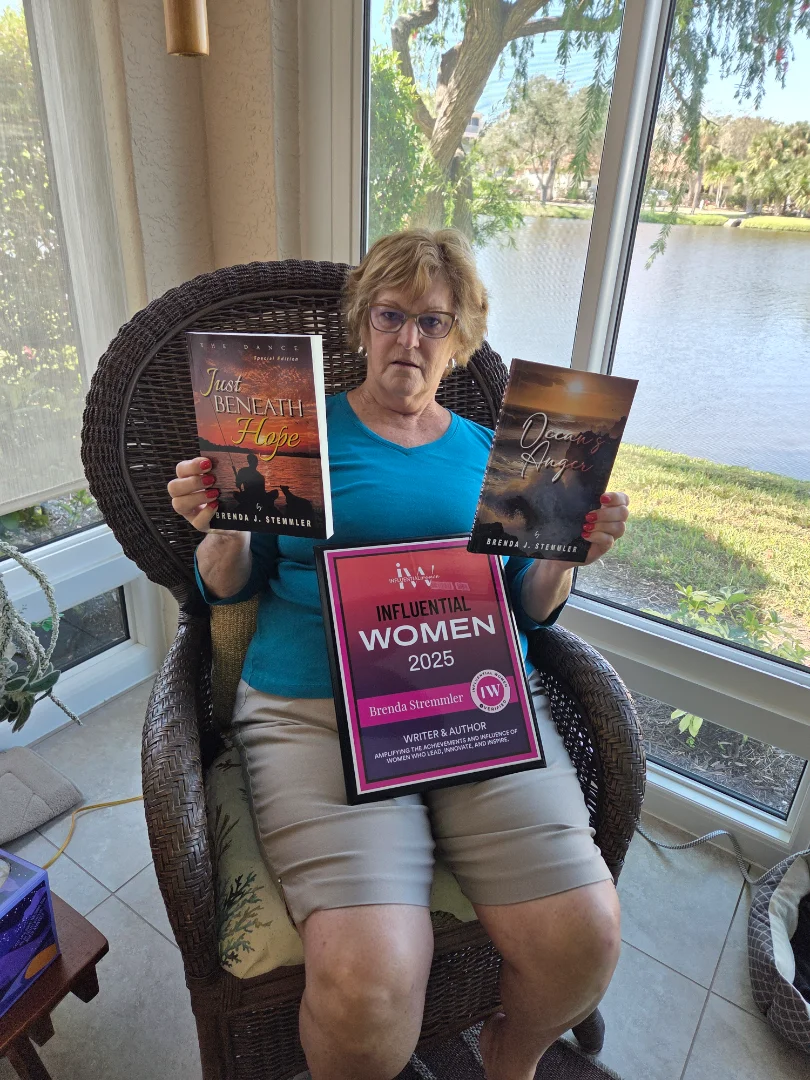
That moment helped crack open a door she had not fully seen in herself. Writing then became a method for her to fit the past and the present together, make sense of it in a calm way. Her first book, Ocean’s Anger, came out of a college paper, after that same professor suggested that a book could come from her work. Later on, her poetry also turned into part of her own way of speaking, letting her point at feelings without handing over every last detail. “My poetry allows me not to give away the whole story,” she said.
Her writing comes out of faith and resilience, but it still isnt polished the way that wipes away pain. It feels like something a real person carried for a while, with brokenness in their hands, and yet they still decided to believe in meaning. Stemmler treats words like a legacy, a hand-me-down with weight. Her stories are not written only to entertain, they are written as a return.
“My legacy are words,” she said. “My stories are of faith and resilience. I hope they can give back to the world.”
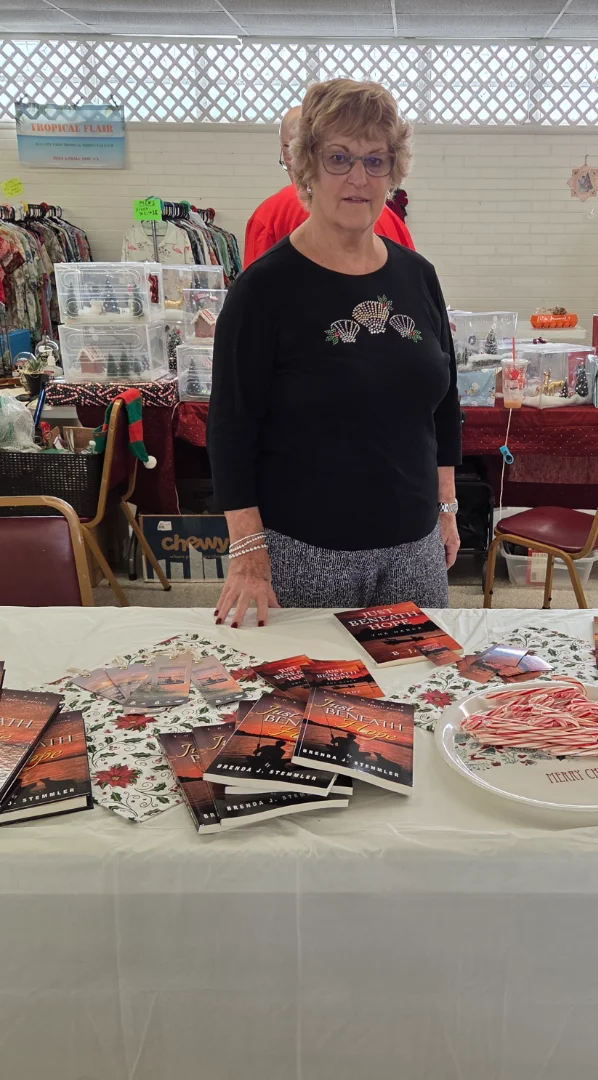
That purpose is most deeply felt in Just Beneath Hope: The Dance, a nonfiction work that was born from love, illness, grief, and a promise.
Amazon: https://www.amazon.com/JustBeneathHopeDanceJade/dp/1546279423
IssueWire Feature: https://www.issuewire.com/a-heartfelt-journey-of-love-and-resilience-1777475388379942
Facebook: https://www.facebook.com/brendastemmlerbooks/

The Story Bob Asked Her to Tell
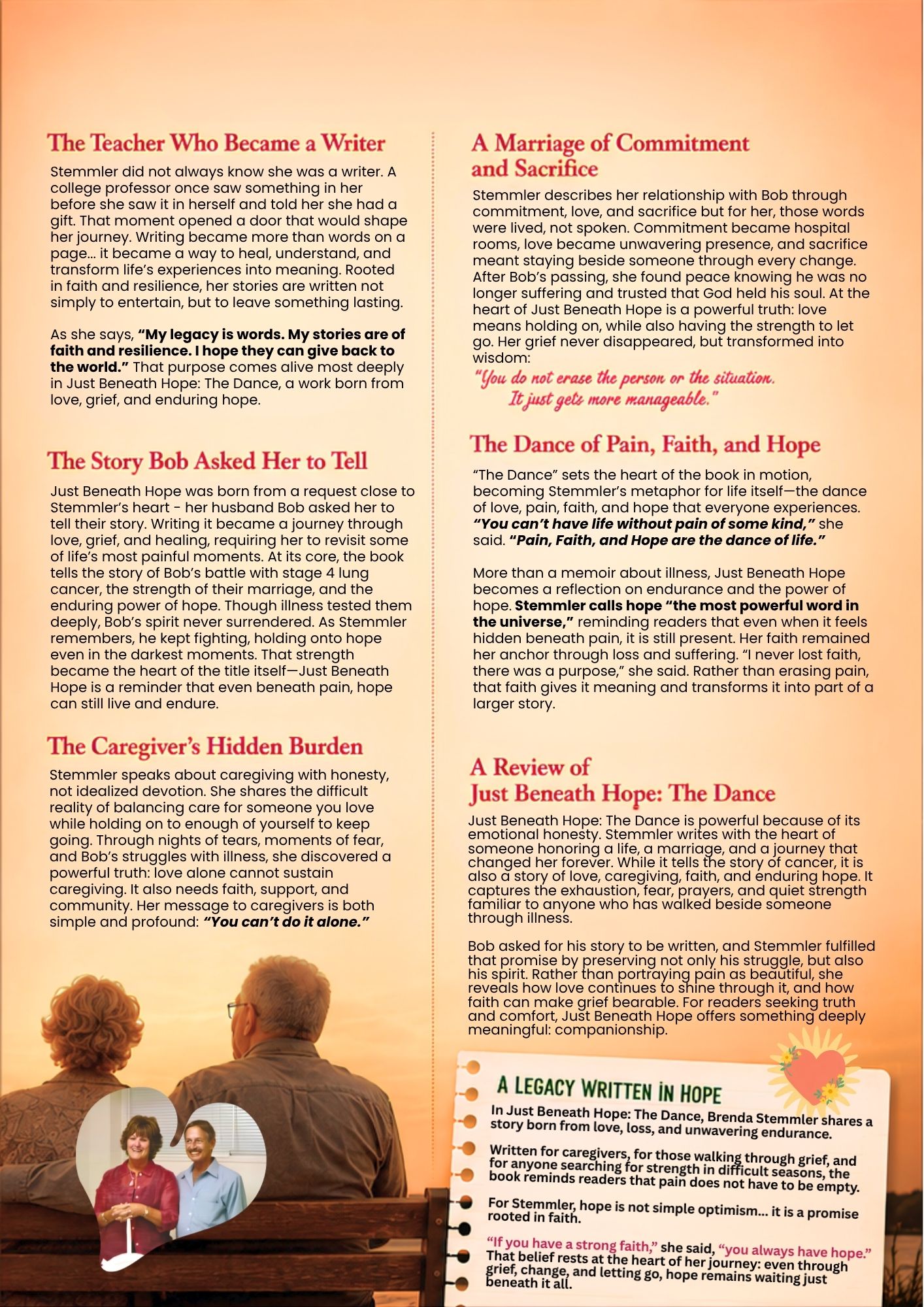
The inspiration behind Just Beneath Hope came from Bob, Stemmler’s husband. He asked her to write their story, like for real.
It was not a easy request to fulfill. The book took years to get finished because life kept interrupting, and also because the act of writing pushed Stemmler to step back into moments that still hurt. Even now, rereading the book is difficult. The story was not just remembered, it had to be relived.
“The hardest part in writing our story was the letting go and holding on at the same time,” she said. “It was the process of grieving, all the way through.”
At its heart, Just Beneath Hope: The Dance is about Bob’s illness, their marriage, the weight of caregiving, and this fragile yet persistent force of hope. The book follows the emotional journey of love under pressure, a life reshaped by illness, and a woman trying to look after the man she loved while also managing the ache that comes from watching him suffer.
Bob was diagnosed with stage 4 lung cancer and the illness tried more than just his body, it tested the emotional architecture, of their marriage too. Still, Stemmler does not frame him as a man that sickness already owned. She recalls his spirit, his fight, and the way he kept refusing to give up. “Bob was not the man that gave up on anything,” she said.
In her view, his strength was like a mustard seed. Small, maybe overlooked by other people, yet alive with possibility. “No one took him seriously,” she said, “His spirit was that of a Peter Pan, and his spirit was always fighting to capture Hope.”
That is also where the title gains its real emotional force. Just Beneath Hope is not a sentence about surrender. It sounds more like a description of a man holding on, even when hope seemed buried under pain, and he did not let it be the end.
The Caregiver’s Hidden Burden
One of the most affecting pieces in Stemmler’s story is her frankness about caregiving. She doesn’t dress it up, no glow, no easy halo. She isn’t describing it as effortless devotion, even if it sounds nice in theory. She just gives the truth, and honestly that part lands hard. People who do this work are tired. They have to make some kind of equilibrium between tending to someone else, and holding onto enough of themselves to keep going.
“There are so many things you have no control over” she said.
At night she cried. On the spiritual side, she realized she needed faith. In a very practical sense too she understood that if she didn’t tend to her own body, mind, and rhythms, then she wouldn’t be able to tend to Bob. That ends up being one of the deepest lessons she shares. Love can ask a lot from a person but caregiving cannot run only on sacrifice, it breaks down when that’s the only fuel. It needs support , it needs prayer , it needs community.
There were frightening moments, especially when Bob’s ammonia levels became high. He would try to push his way out of the pain, too proud to accept help even when it was right there. Stemmler would sometimes end up calling the police first, before an ambulance could take him to the hospital. It hurt her deeply because she knew he was not a cruel person. He was just a man in pain, trying to grip onto hope, with shaking hands.
The book gets its emotional weight from this kind of truth, and yes it is plain. It recognizes that illness does not always look graceful. It can be confusing, it can be frightening, and it stays deeply human. Stemmler writes from inside that reality, not from some safe distance where you can pretend nothing touches you.
Her advice to other caregivers is steady and caring, lean on a support group and your faith. “You can’t do it alone,” she said.
A Marriage of Commitment and Sacrifice
Stemmler frames her tie with Bob in the vocabulary of marriage: commitment, love, and sacrifice. Those terms can feel familiar, almost ceremonial , but in her account they get tried in the deepest ways. Commitment turns into hospital rooms. Love turns into weary, steady exhaustion. Sacrifice becomes the choice to remain there, present with someone you love, even while they change right in front of you.
After the machines were turned off Stemmler watched Bob’s face and found peace. It was the peace of a man no longer in pain. It was also the quiet of a woman who trusted that God had his soul. Bob, she says, was not afraid to die. He was afraid of leaving.
That difference sits at the core of the book. Just Beneath Hope is not only about death, and it is not only. It is about the attachments that make dying feel so brutal. It is about the almost unbearable tenderness of loving someone enough to ask that they stay, and also loving them enough to want their suffering to end.
Stemmler’s grief didn’t really vanish. It shifted, like, into a different shape. “Grief comes in all forms,” she said. “You do not erase the person or the situation. It just gets more manageable.”
That line holds the hushed sense wisdom from someone who stopped trying to sprint away from grief. She sees it as something woven into daily life, not removed from it.
The Dance of Pain, Faith, and Hope
The poem “The Dance” kinda sets the spirit of the book in motion, like right away. For Stemmler, this dance becomes a metaphor for living, life itself. It is that dance of love, the dance of pain, and then the dance of hope too. Everybody moves with life, but the rhythm is guided by need, circumstance, faith, and longing, somehow.
“You can’t have life without pain of some kind,” she said. “Pain, Faith, and Hope are the dance of life.”
This is also where Just Beneath Hope stops being only a memoir about illness. It turns into a more reflective meditation on endurance. Stemmler even defines hope as “the most powerful word in the universe,” and then she invites readers to notice how often the word keeps showing up in everyday speech. People hope for healing, hope for peace, hope for time, hope for answers, hope for one more ordinary day.
To live just beneath hope, in Stemmler’s view, is not to live without it. Instead, it is to understand that hope may not always feel visible, but it is still there. It waits under the surface, it waits beneath the pain.
Bob knew , she thinks , that there was a better place without pain . Her faith never really left her side . “I never lost faith , there was a purpose ” she said .
That faith kind of shapes the book emotional core. It does not remove suffering, but it gives suffering a kind of frame . It lets pain turn into part of a wider story instead of being the final page .
A Review of Just Beneath Hope: The Dance
As a book, Just Beneath Hope: The Dance is most compelling when it is at its most intimate, even when the pages feel plain. Its pull is not in some huge, literary show, but in the emotional sincerity that keeps returning. Stemmler writes like someone trying to honor a life, a marriage, and a season of suffering that changed her forever.
The narrative kind of tucks readers into the private world of Bob and Brenda, from love and companionship into illness and loss. It is, yes, a story about cancer. But it is not only that, there is more. It is a caregiver’s story, a faith story too. And it reads like a love story written after the storm, by someone still able to see the light that made it through.
Anyone who has cared for a spouse, parent, sibling, child, or even a close friend through serious illness will recognize the emotional landscape, the exhaustion, the fear, the helplessness.

The prayers spoken quietly, then the moments of guilt for needing rest. The strange, complicated relief when the suffering finally ends. Stemmler gives these experiences a real voice, without sanding them down into easy sentimentality.
The book also works like a reflection on legacy. Bob asked for the story to be written , and Stemmler answered the request by keeping not only his illness, but his spirit too. He shows up as a man who fought , hoped , feared leaving and eventually found peace.
There is a rawness in the story that gives it credibility. Stemmler does not act like pain is beautiful. Instead she shows how love keeps glowing through it. She does not say grief is easy, but she shows that faith can help grief stay survivable.
For readers who want a polished and distant account of illness, this may feel too close. But for readers who are looking for truth, comfort, and recognition, Just Beneath Hope offers something a bit more precious: companionship.
The Woman Behind the Words
Beyond the authors name there is a woman who loves deeply , and yes she means it. Stemmler talks about her family and a few close friends, as if they are woven into her identity. Motherhood, she says, is the best thing she has ever done. Seeing her sons expand and meet their ambitions brings her joy, quiet and steady. Being a grandmother, well that is another type of love where she can pause, step back, and just observe her grandchildren learn through mistakes, find their way, and hold to faith.
She says she is blessed , that her sons and grandchildren always end up at church.
This small detail matters because it ties the start of her story to right now. The young girl whose grandfather brought her to church grew into a woman who placed her whole life on faith. The child who experienced pain became someone who teaches compassion. The wife who felt grief later became an author of hope.
Her story is not only about what happened to her. It is also about what she decided to do with it, what direction she gave the experience.
A Legacy Written in Hope
In Just Beneath Hope: The Dance, Brenda Stemmler offers something that comes from love and from loss, but also from endurance. It feels made for people who were caregivers, for those who have been grieving, for anyone who has seen illness slowly rearrange the person you love, and for those who still think faith can steady them when life becomes too heavy to keep carrying by themselves.
Her life, and the work she did, brings a reminder that pain is going to happen, yes, yet it does not have to be empty. For Stemmler, hope is not quick bright optimism. Hope is a promise. It is the conviction that God will tend to you even when life, well, breaks your heart open.
“If you have a strong faith,” she said, “you always have hope.”
That line sits at the heart of her journey. It is also the message her book keeps repeating after the last page. The dance can bring pain with it. It can bring grief. It can bring the unending labor of letting go, while still holding on. Still, just beneath all of it, Stemmler maintains, there is hope.