

There’s a moment in almost every tennis lesson where instinct and instruction kind of bump into each other, not gently. A coach is standing right by the court basket, feeding ball after ball, repeating the same familiar corrections, like move your feet, watch the contact point, and finish the swing. The player makes small adjustments, gets a bit better for a moment, then drifts back into those old habits anyway. And yeah, this loop plays out again and again on courts everywhere across the world.
For decades, a lot of tennis coaching has leaned on repetition plus intuition, the kind of methods that get passed along from one coaching generation to the next, like it’s just how it’s always been. But for Andy Dowsett, who coaches and teaches through System-9 Tennis, that usual path leaves too much in the dark, too many parts not really explained.
His real question isn’t only about how players improve. It’s more like, how do coaches actually think, under the surface?


Through his platform @system9tennis, Dowsett has placed himself inside a broader wave of modern coaching educators who are trying to add structure, clearer reasoning, and systems-based thinking to tennis training. And his message is pretty blunt: tennis coaching, as a whole, deserves a re-imagining.

Coaching the Coach
Unlike many tennis accounts on social media, System-9 is not built primarily around player highlights or motivational content. Instead, the focus is educational.
Dowsett describes System-9 as a methodology “built for coaches who want to get serious,” offering books, courses, and structured frameworks aimed at improving coaching systems rather than simply teaching strokes. Through Instagram, Facebook, and long-form educational materials, he presents coaching as a discipline requiring deliberate methodology: not just experience alone.
This distinction matters.
In tennis, elite players do not automatically become elite coaches. Coaching requires its own language:
- Observation
- Communication
- Progression planning
- Technical analysis
- Psychological understanding
System-9 appears designed around organizing these elements into repeatable frameworks.


The Rise of Systems Thinking in Sport
Dowsett’s philosophy reflects a broader evolution in modern sports training.
Across professional athletics, coaching has increasingly shifted toward systems-based performance models – approaches that combine biomechanics, psychology, data analysis, and skill acquisition theory into cohesive structures.
In tennis specifically, modern coaching has moved beyond purely technical instruction. Researchers and high-performance programs now emphasize:
- Decision-making under pressure
- Pattern recognition
- Movement efficiency
- Constraint-based learning
- Match intelligence
This shift mirrors trends in other elite sports where coaches operate less like instructors and more like performance architects.
System-9 appears to sit within this new generation of thinking: structured, analytical, and process-driven.
Social Media as a Coaching Classroom
Instagram has kind of transformed sports education.
What used to mean going to seminars, or doing full certification courses, can now be accessed partially through reels, breakdown videos, and those digital coaching communities. Coaches are using social media not just for marketing, though, but more for pro-growth and knowledge exchanges, like day-by-day learning in public.
The @system9tennis account, honestly, feels less like a lifestyle feed and more like a coaching laboratory, where you can almost “watch” thinking happen.
Most posts lean into things like
- Tactical concepts
- Technical frameworks
- Player development ideas
- Communication methods
- Coaching philosophy
The tone reads instructional, not performative. it doesn’t really chase hype. That educational emphasis is what separates System-9 from the wider stream of tennis content, which often tends to favor entertainment, or very player-first branding.
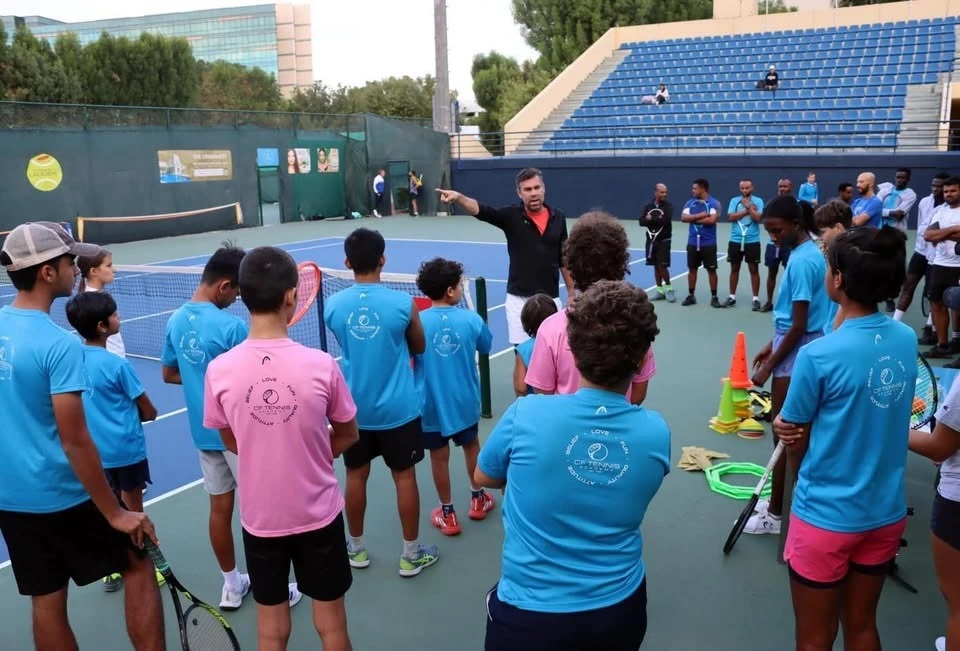
Methodology Over Motivation
One of the more defining characteristics in Dowsett’s presentation is how he emphasizes systems over slogans – the whole message gets more grounded. Many coaching brands rely heavily on inspiration, for example: work harder, trust the process, never give up. System-9 instead leans into methodology, more than the motivational poster stuff.
This kind of also reflects an important reality in skill acquisition: motivation can keep one moving, but structure is what decides progress. A player repeating ineffective patterns thousands of times does not necessarily get better, even if they feel consistent about it. Modern coaching is increasingly recognizing that development depends on carefully designed environments, and on feedback systems too.
Dowsett’s work seems rooted in this same idea – that better coaching outcomes come from better coaching structures, and not only from louder encouragement.
The Business of Modern Coaching Education
System-9 also kind of reflects the changing economics of sports education. Historically, coaching knowledge was held together within federations, academies, or private mentorships.

But now digital platforms let independent educators build audiences that reach all over the world, still focused on specialized methodologies, like it’s more or less routine.
Through books, courses, and educational resources, coaches like Dowsett can now teach well past their local courts. In a way, this shift matches wider trends in online education, like:
- Expertise becomes scalable
- Communities turn global
- Niche knowledge becomes accessible
For tennis coaches inside smaller programs or in more isolated environments, these digital education platforms provide access to ideas that used to be limited by geography, not by anything else.

Tennis Beyond Technique
Perhaps the most compelling aspect of System-9 is its implication that tennis is not merely physical.
The modern game demands:
- Tactical adaptability
- Emotional regulation
- Pattern anticipation
- Decision speed
- Situational awareness
Elite coaching, therefore, requires understanding the sport as a complex system rather than a collection of isolated strokes.
This systems-oriented philosophy aligns with contemporary research in ecological dynamics and skill acquisition theory, which suggests that athletes learn best through representative environments and adaptive problem-solving rather than rigid repetition alone.
In simpler terms:
Players improve not just by practicing shots, but by learning how to solve tennis problems in real time.

Building Better Coaches
At its core, System-9 asks a deeper question about tennis development:
What if the greatest limitation in player development is not the athlete, but the structure of coaching itself?
It is a provocative idea, but one increasingly explored across elite sports.
Better systems create better learning environments.
Better learning environments create better athletes.
From this perspective, coaching education becomes one of the most important performance variables in sport.
A New Era of Tennis Instruction
Andy Dowsett’s work lands at a time when coaching is shifting really fast, like it’s half as fast as it feels. Technology, online training, sports science, and digital communities have basically re-mapped how know-how travels through the tennis world. Coaches are no longer boxed in by local traditions or by what was passed down, kind of like “that’s how it’s always been.” Now they can look around globally, compare different systems, and keep tuning their coaching style as things evolve.
System-9 kind of mirrors this newer landscape, it’s not just talk or vibes:

- Analytical, rather than purely instinctive
- Structured rather than improvised
- Educational rather than promotional
And maybe the biggest part is that it re-frames coaching as something that deserves real deep attention, like study-worthy, not just “do what you’ve always done.” Because usually behind every player who keeps getting better, there’s an even better coach, working on their craft, quietly, day after day.
So, in the end, that might be where the real progression starts.
Get Connected and Learn More
- Follow Andy Dowsett and System-9 Tennis on Instagram:
https://www.instagram.com/system9tennis/ - Connect with System-9 Tennis on Facebook:
https://www.facebook.com/238264486697761 - Explore books, courses, and coaching resources from System-9 Tennis:
https://linktr.ee/system9tennis